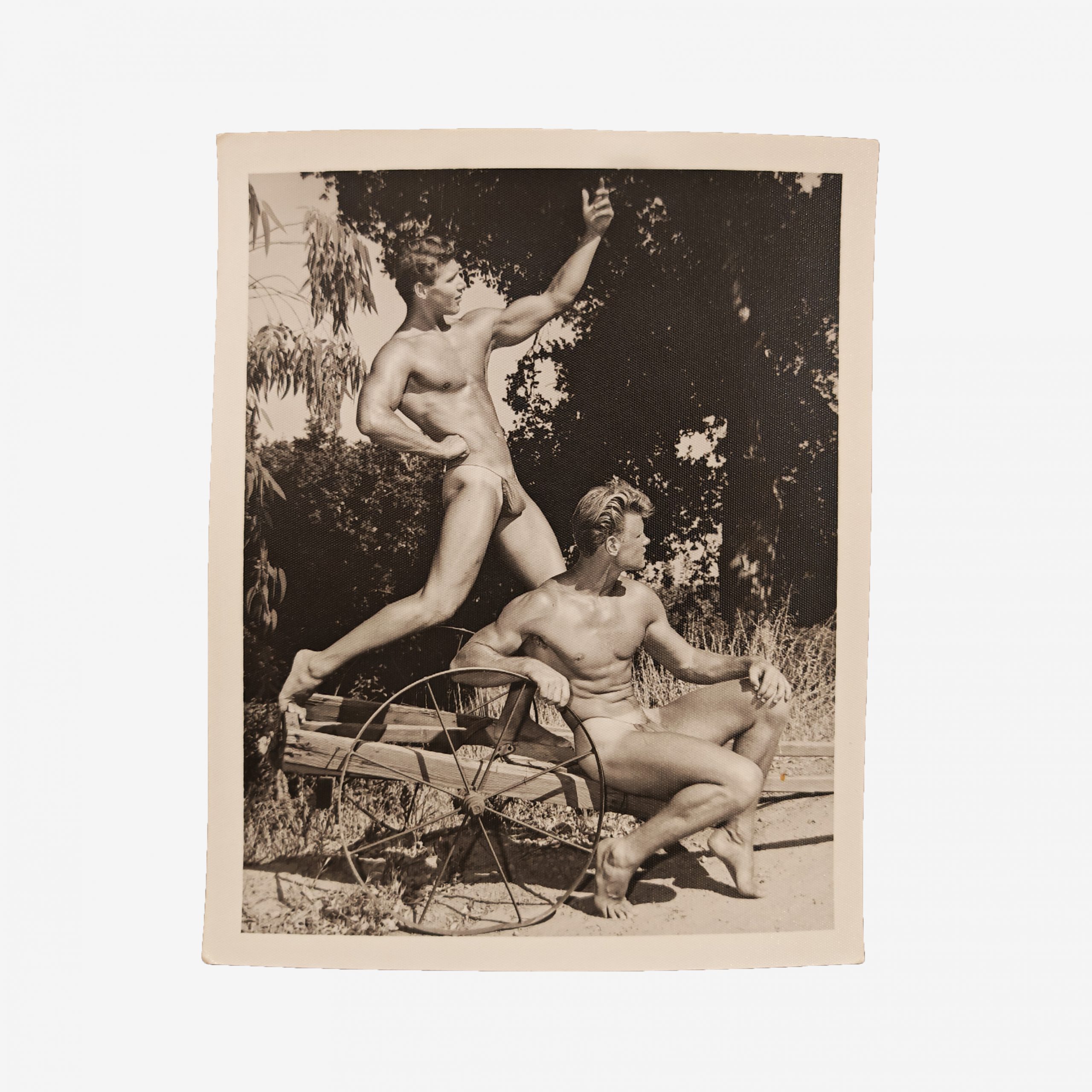
This Bruce of Los Angeles Original Print from 1954 represents a peak moment in the career of Bruce Bellas. During this period, Bellas perfected the art of the “double subject” study. These compositions allowed him to explore the interplay of light and shadow across two distinct physiques. Furthermore, his work helped define the mid-century Physique Photography movement as a serious art form.
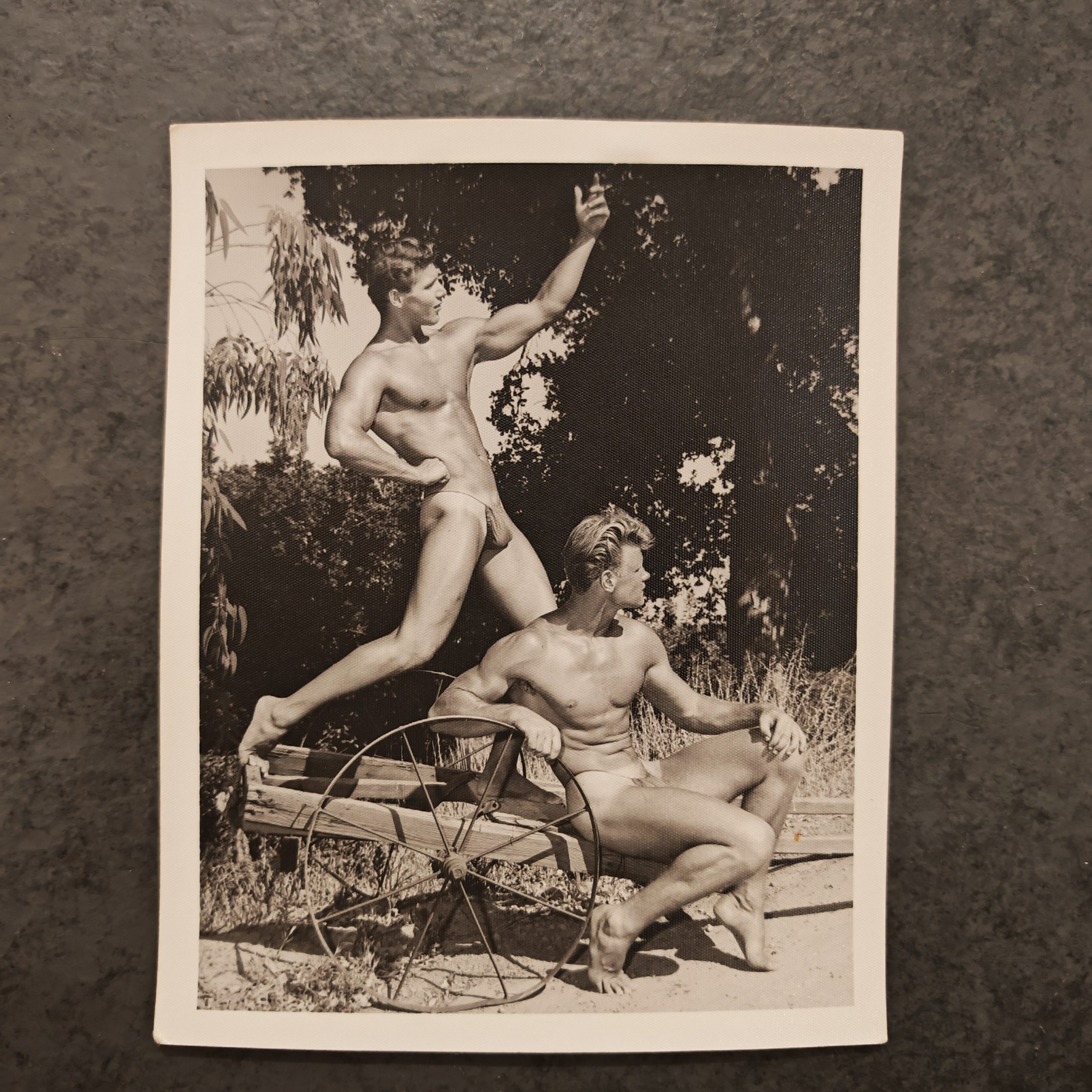
In this striking scene, two models pose upon a rustic wooden cart in a natural outdoor setting. This Bruce of Los Angeles Original Print utilizes a classical, Greco-Roman inspired arrangement. One model stands in an elevated, dynamic pose, while the second sits below in a relaxed, contemplative position. This vertical hierarchy creates a powerful visual narrative that evokes ancient mythology. Moreover, the inclusion of the wooden cart adds a layer of Americana and theatricality. As a result, the image transcends simple documentation to become a sophisticated celebration of masculine beauty and natural light.
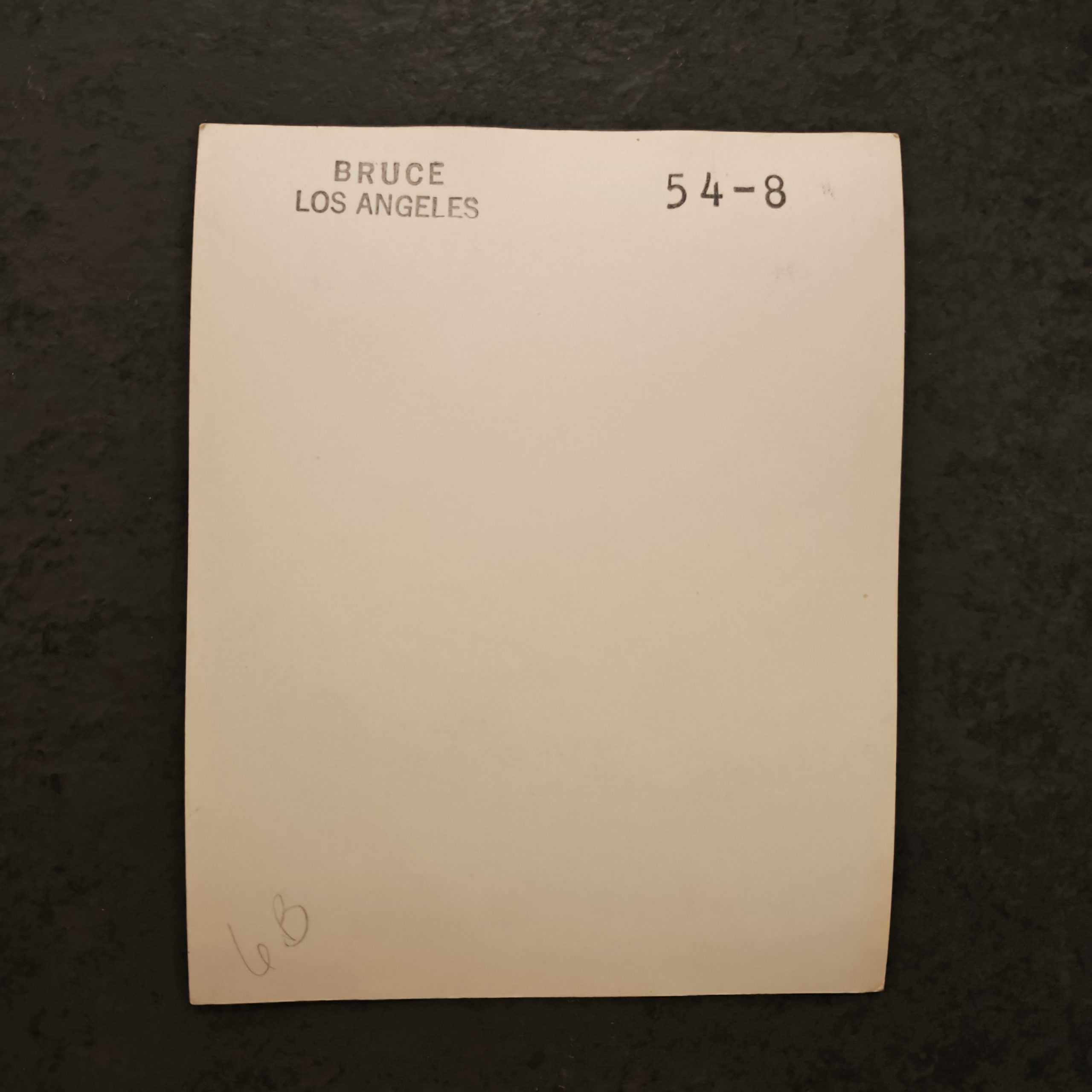
The technical execution of this silver gelatin print highlights Bellas’s mastery of the darkroom. Because he utilized a chemical-heavy process, the print displays deep blacks and brilliant, sun-drenched highlights. Every muscle fiber and skin texture remains crisp, showcasing the superior resolution of mid-century large-format cameras. Additionally, the reverse side provides undeniable proof of authenticity. The original “BRUCE LOS ANGELES” ink stamp and the “54-8” date stamp verify its production in August 1954. Therefore, this piece serves as a reliable and chemically stable artifact for the discerning investor. You can consult our guide on Collecting Vintage Photography for more technical insights.
Acquiring a Bruce of Los Angeles Original Print is an essential move for any serious collection of 20th-century figurative art. Bellas’s work is now recognized internationally, with pieces held in major institutions like the Los Angeles County Museum of Art (LACMA). This dual-model study is particularly valuable because of its complex staging and rare outdoor location. Consequently, it represents the freedom and artistic defiance of mid-century queer visual culture. In conclusion, this photograph is more than an image; it is a stable historical asset with enduring cultural significance.


 No products in the cart.