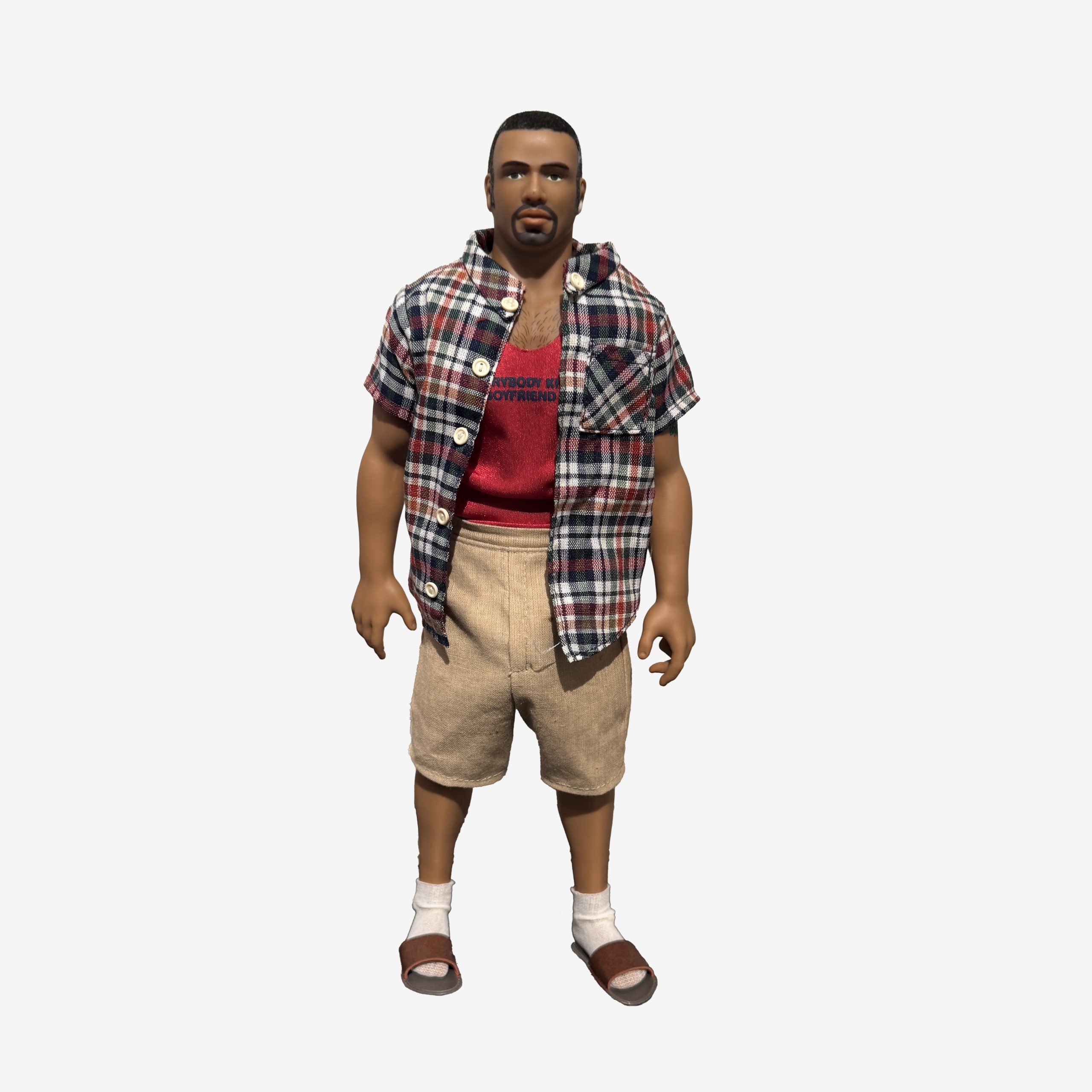
Vacation Carlos
Relaxed, confident, and effortlessly stylish, Vacation Carlos (1998) is the ultimate getaway fantasy. Wearing a red tank top with the cheeky text “Nobody Knows I’m Your Boyfriend,” a plaid short-sleeve shirt, beige shorts, and brown sandals, he radiates casual charm with a subversive wink. His laid-back style is balanced by thoughtful details—from the visible chest hair to the socks-with-sandals touch—celebrating queer joy in everyday moments.
Carlos, introduced in 1998 as part of the extended Billy universe, was a landmark moment in LGBTQ+ doll history—bringing greater representation and cultural nuance. Vacation Carlos embodies the idea that pride doesn’t pause when you’re off duty. Whether by the beach or strolling through the city, he reminds us that rest and visibility can go hand in hand.
John McKitterick & Juan Andrés
In the late 1980s, amidst London’s tense political climate under Margaret Thatcher and the devastating impact of the AIDS epidemic, artists John McKitterick and Juan Andres began an ambitious collaboration that merged art, politics, and sexuality. Together, they conceived Billy not merely as an artwork, but as a cultural statement — a symbol of pride, visibility, and resistance.
McKitterick and Andres envisioned Billy as a conceptual project from the very beginning: a work that could exist simultaneously within the realms of contemporary art and popular culture. Every aspect was premeditated — from the initial sculpture to future exhibitions, books, films, music, and products — all intended to spread a message of diversity and awareness beyond the traditional art world.
When Billy was first exhibited in 1994 at The Freedom Gallery in Soho, the response was immediate and polarizing. The duo’s creation was celebrated internationally, applauded for its courage and creativity, and criticized by more conservative audiences, which only reinforced its visibility and relevance.
Three years later, McKitterick and Andres transformed their artistic vision into a mass-produced object: Billy – The World’s First Out and Proud Gay Doll. What began as a provocative sculpture became a global icon, sold in hundreds of stores, dressed by designers like Alexander McQueen, and exhibited in major institutions such as the Andy Warhol Museum, the Science Museum in London, and The New Museum of Contemporary Art in New York.
Through Billy, McKitterick and Andres succeeded in transcending artistic boundaries, creating one of the first cultural bridges between queer identity and mainstream visibility. Their work stands as a testament to how art can embody resistance, inspire dialogue, and transform social consciousness.




 No products in the cart.