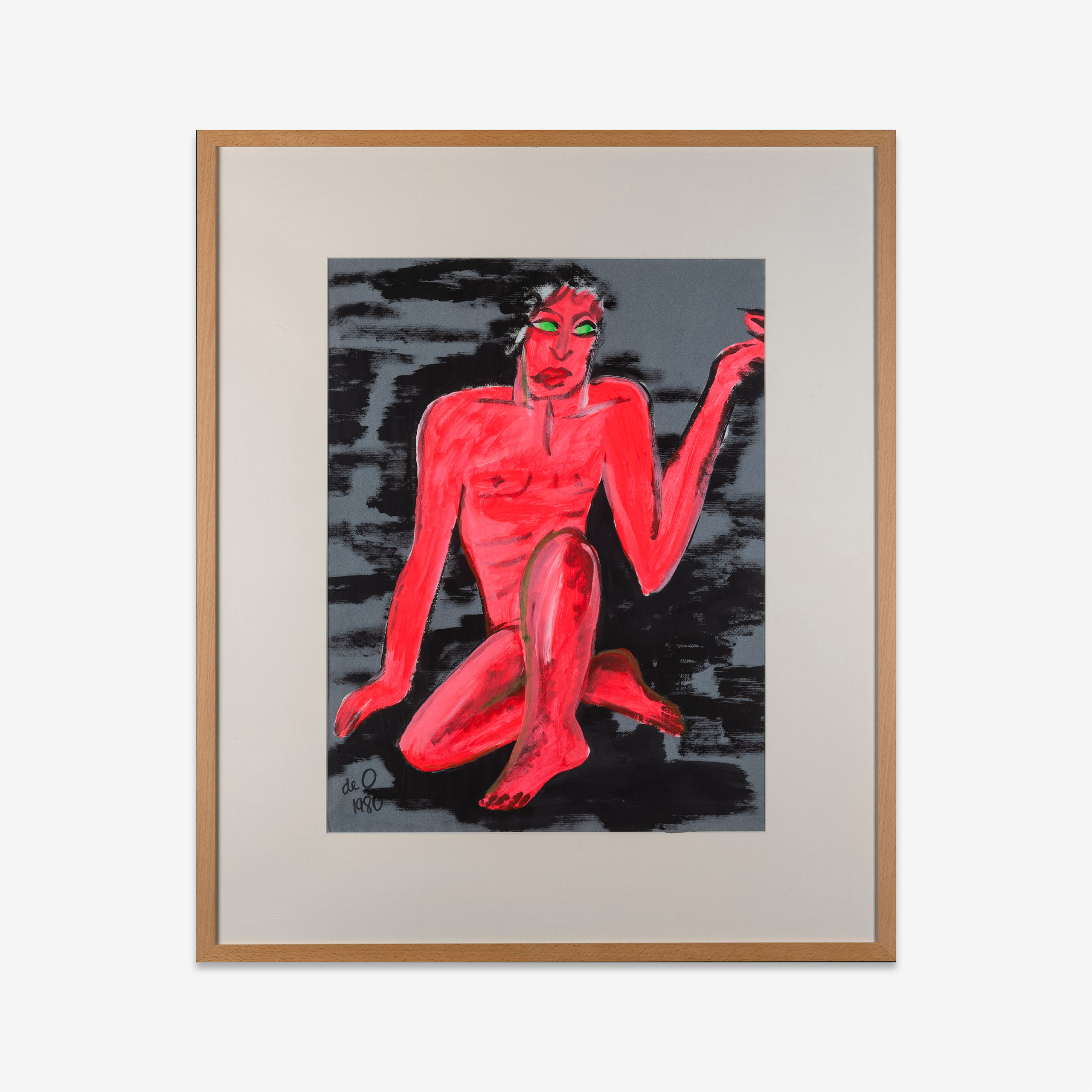
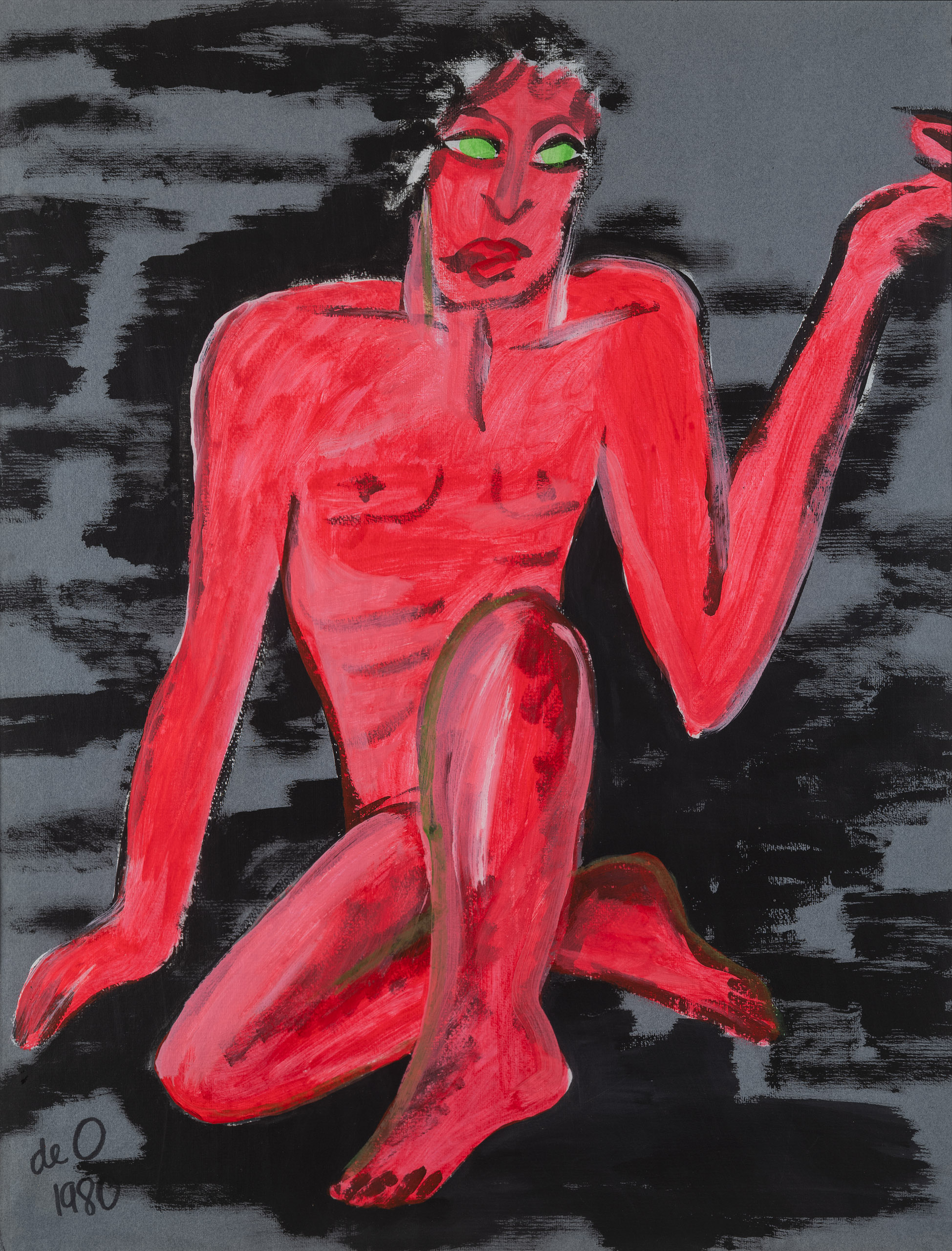
“Diablo de ojos verdes” is a notable work on paper created by Juan José Carrero Galofré, known as Juan de O, during the early years of the 1980s, a moment in which his visual language was consolidating within the collaborative universe of Costus. This period is marked by a deliberate exploration of the human figure not as a naturalistic subject, but as a constructed symbol capable of carrying psychological, theatrical and cultural dimensions. The work reveals this approach clearly: a red, stylised body emerges from a dark, textured background, articulated through a palette chosen for its structural clarity rather than narrative sentiment.
The use of mixed media on paper is characteristic of Juan de O’s working process at the time. Paper provided an agile, responsive surface that allowed him to experiment with gesture, colour blocks and the articulation of the figure with a freedom not always present in his larger canvases. In this piece, layers of bright red pigment define the figure’s musculature and posture, while swift black brushstrokes interrupt the background, creating a fragmented space that functions more as a conceptual stage than a representational environment. The composition demonstrates the artist’s interest in the relationship between the body and its surrounding void, a recurring aspect in the broader practice of Costus during these formative years.
The figure—kneeling, frontal and marked by sharply defined green eyes—occupies the central field with a presence that is more emblematic than narrative. The posture, along with the simplified anatomy, suggests an archetype rather than a specific individual. Juan de O frequently developed characters whose expressiveness derived from graphic economy and formal tension. Here, the “devil” appears not as an icon of myth but as a coded body, shaped through contrasts of hue, density and gesture. The eyes, in particular, introduce a counterpoint within the chromatic structure, anchoring the viewer’s gaze and providing the sole tonal disruption to the monochromatic interplay between red and black.
The dating and signatures on recto (“de O 1980”) and verso (“de O 81”) situate the work within a transitional moment in which Juan de O was intensifying his visual research into the body, identity and the performative dimension of painting. These years saw the development of many of the ideas that would later define the joint production of Costus and their relevance within the cultural landscape of the Spanish Transition. Although executed on paper, this work synthesises key aspects of that evolving language: immediacy, experimentation and the construction of figures that oscillate between personal myth-making and cultural symbolism.
For collectors, “Diablo de ojos verdes” stands as a concise yet compelling example of Juan de O’s approach to figurative invention. Its directness, technical clarity and position within the early 1980s make it a significant piece for understanding both the artist’s individual trajectory and the wider development of the Costus aesthetic. Works on paper from this period offer a rare proximity to the artist’s exploratory processes, making this an especially valuable addition to a collection focused on Spanish contemporary art or on the visual narratives emerging from the post-dictatorship cultural renewal.


 No products in the cart.