
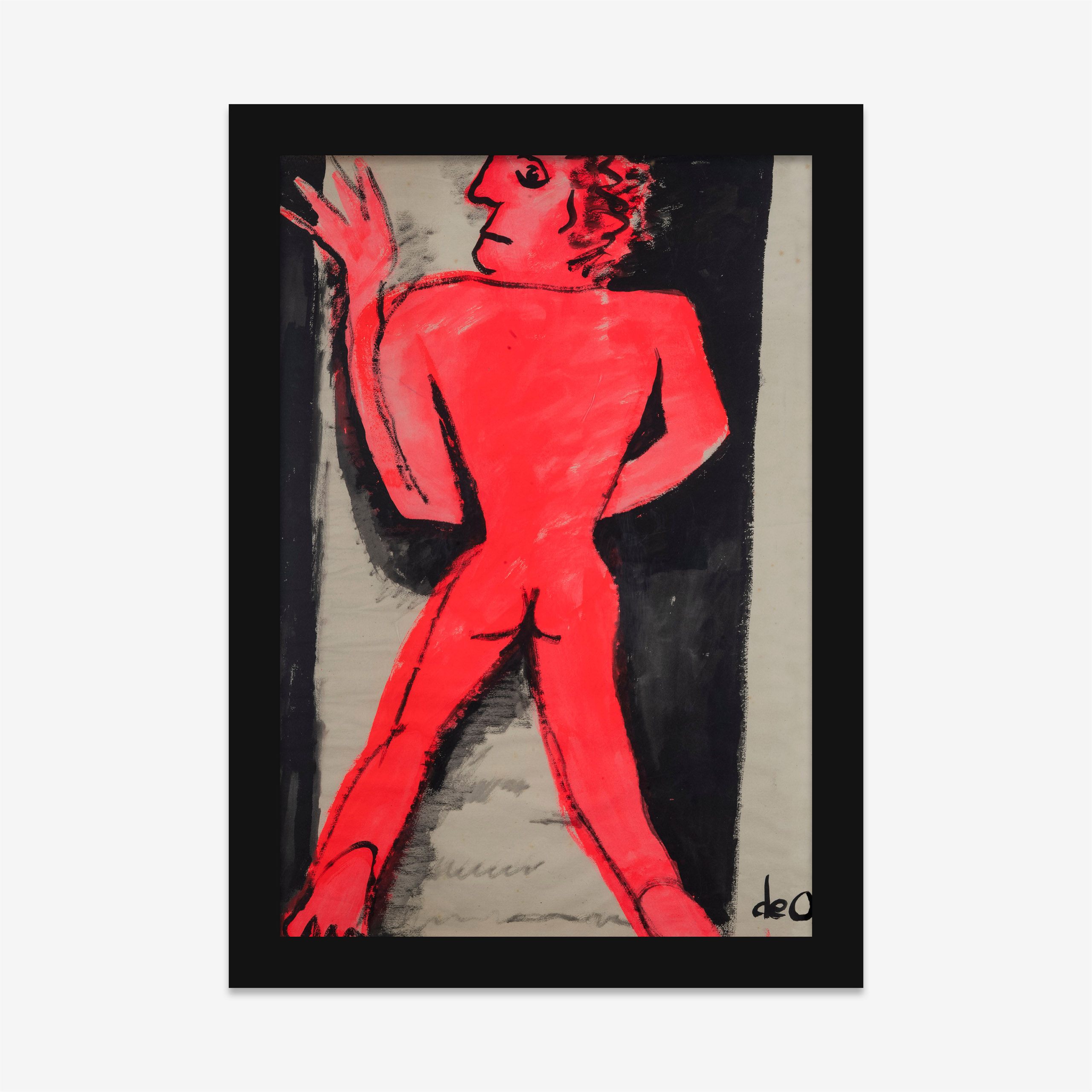
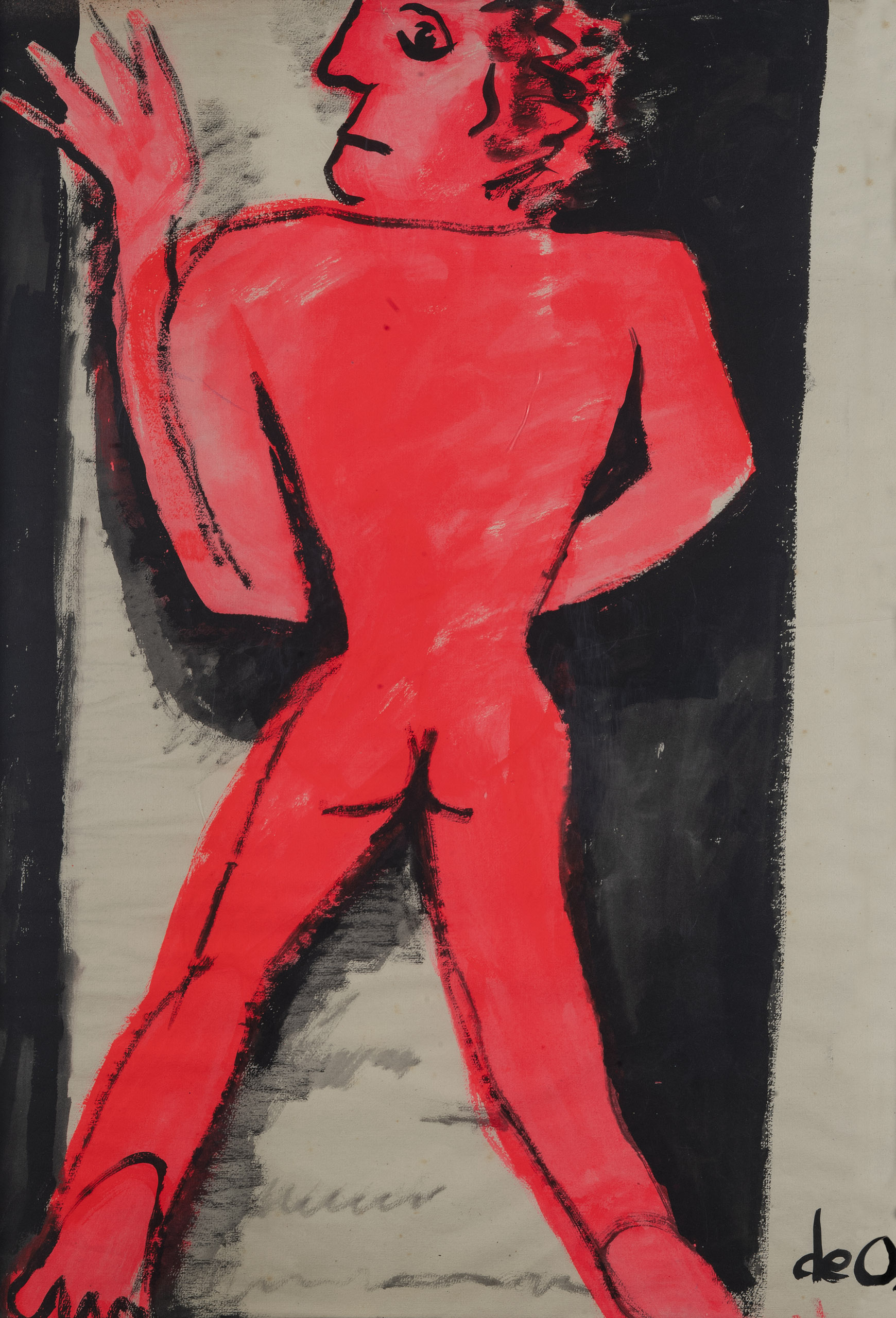
“Hombre rojo de espaldas” is a work that encapsulates one of the most recognisable visual strategies of the Costus project: the use of intense, saturated colour to construct a figure whose presence is defined more by chromatic force than anatomical detail. Executed in acrylic on paper, the piece highlights the capacity of this medium to create both vibrancy and immediacy. The red figure, positioned with its back to the viewer, stands out against a stark, nearly monochrome ground, establishing a contrast that heightens the tension between figure and space. The simplified outlines and evident brushwork show a deliberate rejection of naturalistic modelling in favour of a direct, graphic language closely associated with the late 20th-century underground art scene.
The composition is structured around a vertical axis that emphasises the upright posture of the subject. Despite the absence of detailed facial expression, the slight turn of the head introduces a subtle narrative element, suggesting movement or an awareness of something outside the frame. The artist’s restraint in descriptive detail directs attention instead to the interaction between colour and gesture. The red body operates as a visual anchor, demonstrating how the Costus partnership explored corporeality through stylised, reductionist forms that retain strong visual impact. This approach aligns with their broader practice, which often blended figurative representation with elements of theatricality and graphic immediacy.
The work is signed “de O.”, identifying Juan Carrero Galofré as the executing hand within the Costus duo. His contribution to the project is characterised by a confident, expressive use of line and a compositional clarity that emphasises bold silhouettes. In Hombre rojo de espaldas, these qualities are clearly present, reinforcing the work’s connection to the collective identity of Costus while also reflecting Carrero’s distinctive sensibility. The acrylic medium enhances the intensity of the colour fields, allowing the figure to appear both flat and sculptural depending on the proximity of the viewer.
For collectors and institutions, this piece represents a significant example of the visual vocabulary that defined the Costus narrative: a combination of immediacy, stylisation and chromatic intensity that places the human figure at the centre of an expressive, culturally charged aesthetic. The artwork’s dimensions—68 × 48 cm—make it an optimal size for both standalone display and integration into curated collections focused on Spanish contemporary art, figurative experimentation or the cultural movements surrounding La Movida.


 No products in the cart.