
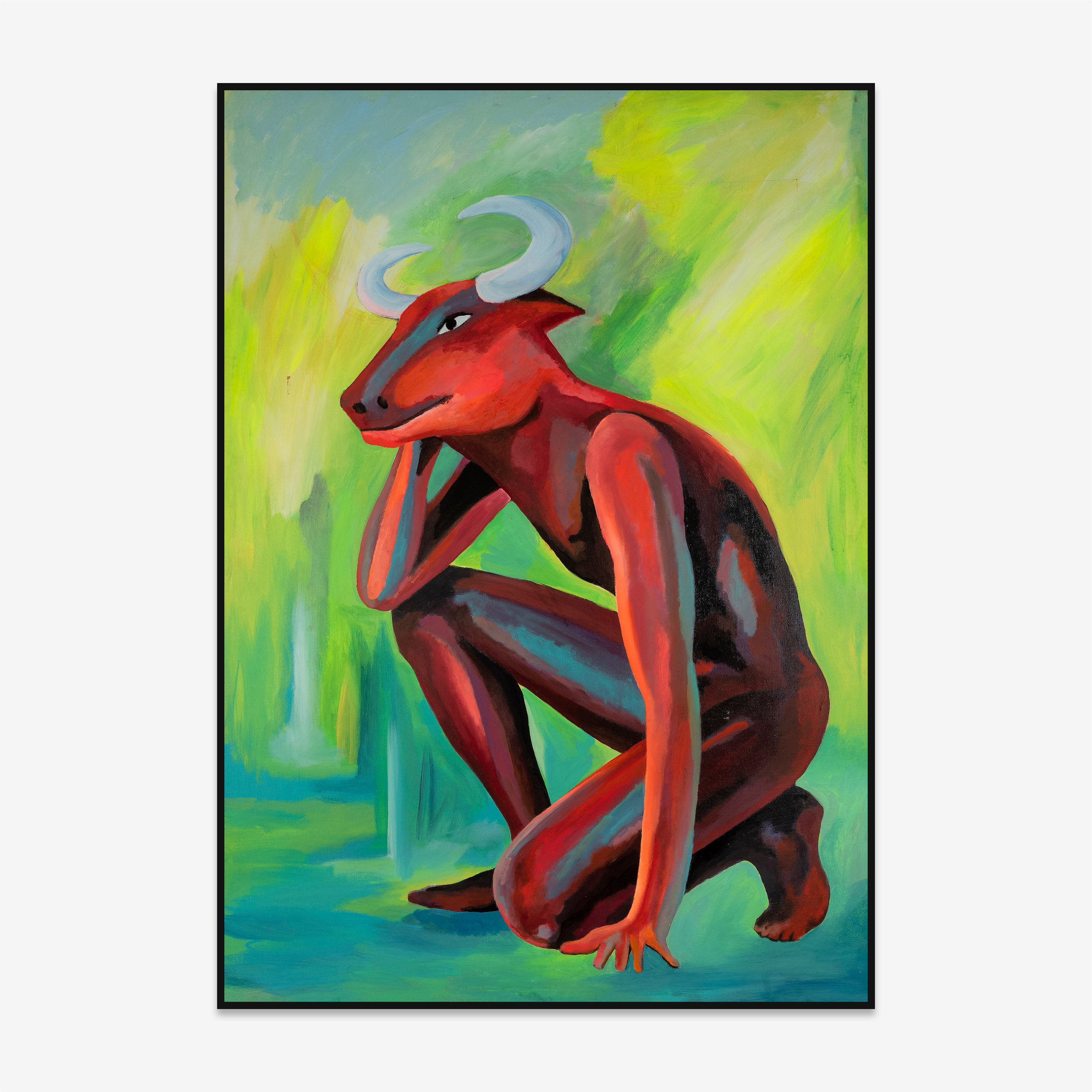
“Minotauro Pensante” is a significant example of how the Costus project incorporated mythological references into a distinctly contemporary visual language. Executed in acrylic on canvas in 1985, the work presents a hybrid creature that merges the human body with the head of a bull, aligning it with the traditional figure of the Minotaur while simultaneously distancing itself from classical dramatic interpretations. Instead of embodying aggression or dominance, the figure is shown in a contemplative pose, kneeling with one arm resting on its knee and the other supporting its head. This unexpected posture shifts the narrative into a more introspective register, positioning the Minotaur as a subject capable of reflection rather than solely as a symbol of mythic violence.
The composition is defined by a vivid chromatic contrast. The figure’s deep red body, modelled through gradients of blue, crimson and earthy tones, stands out powerfully against a luminous background of greens and yellows. This environment, painted with broad and fluid strokes, avoids describing a specific physical setting and instead functions as an atmospheric field that intensifies the presence of the Minotaur. The acrylic medium allows for sharp transitions between saturated colour areas and softer transitions in the modelling of the musculature, underscoring Juan Carrero’s technical control and interest in expressive figuration.
Although unsigned, the work is executed by Juan Carrero Galofré within the Costus duo, and it reflects many of the hallmarks of his contribution to their shared artistic identity. The clarity of the silhouette, the carefully considered anatomy and the balance between stylisation and realism highlight his mastery of form. At the same time, the choice of subject matter links the painting to the broader cultural and artistic context of the 1980s, a period in which Costus explored hybrid identities, symbolic figures and a bold, chromatic reinterpretation of classical themes. The Minotaur, often used in contemporary Spanish art as an emblem of duality and inner conflict, is here reimagined as a figure caught in a moment of quiet thought, expanding the interpretive possibilities of the myth.
With its substantial dimensions of 162 × 115 cm, Minotauro Pensante occupies a commanding physical presence, making it suitable for prominent display in both private and institutional collections. Its combination of mythological reference, expressive colour and a distinctive reinterpretation of the human–animal form situates it as an important piece within the Costus corpus. For collectors interested in Spanish contemporary art, figurative experimentation or the reinterpretation of classical iconography through the lens of late 20th-century aesthetics, this work stands as a compelling and representative example.


 No products in the cart.