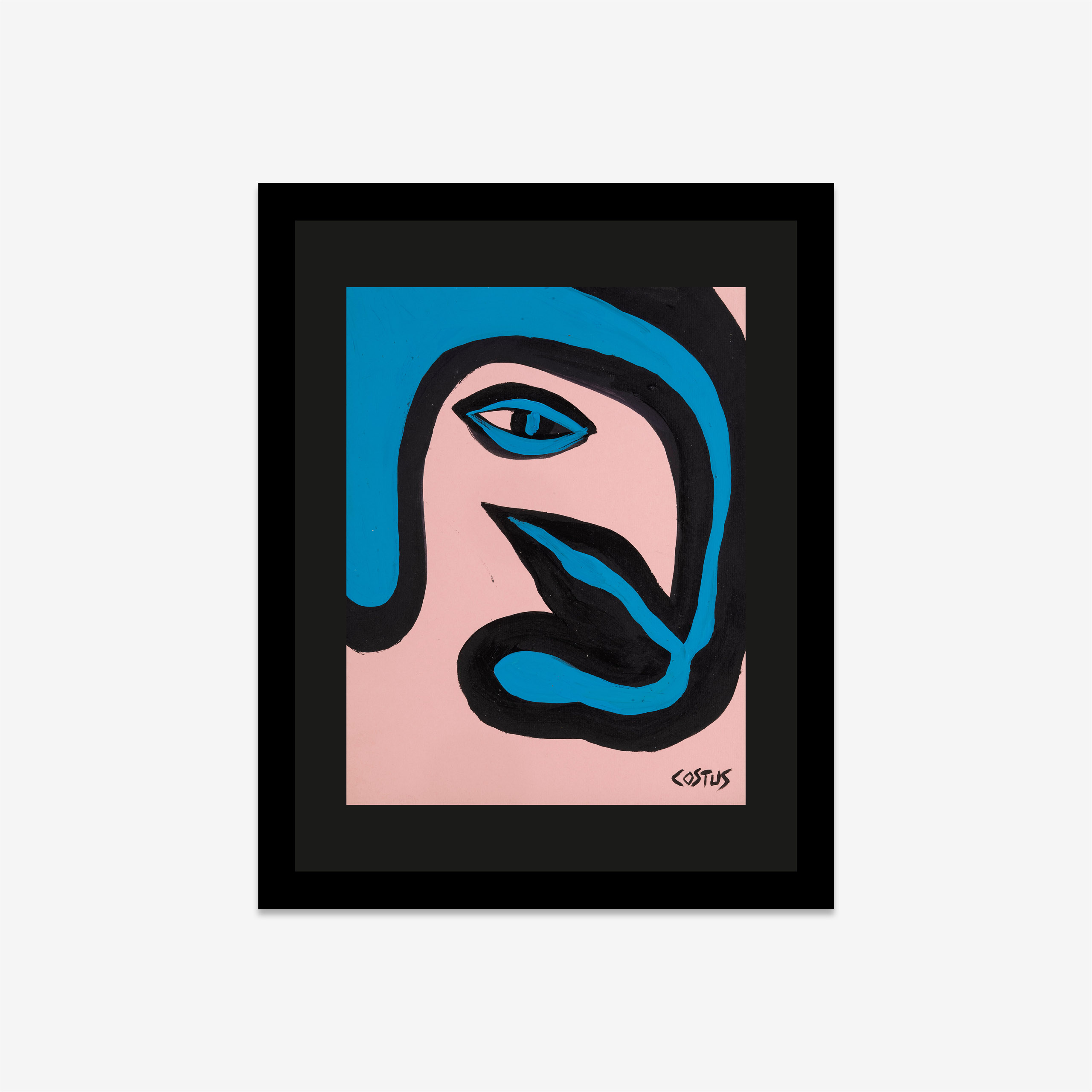
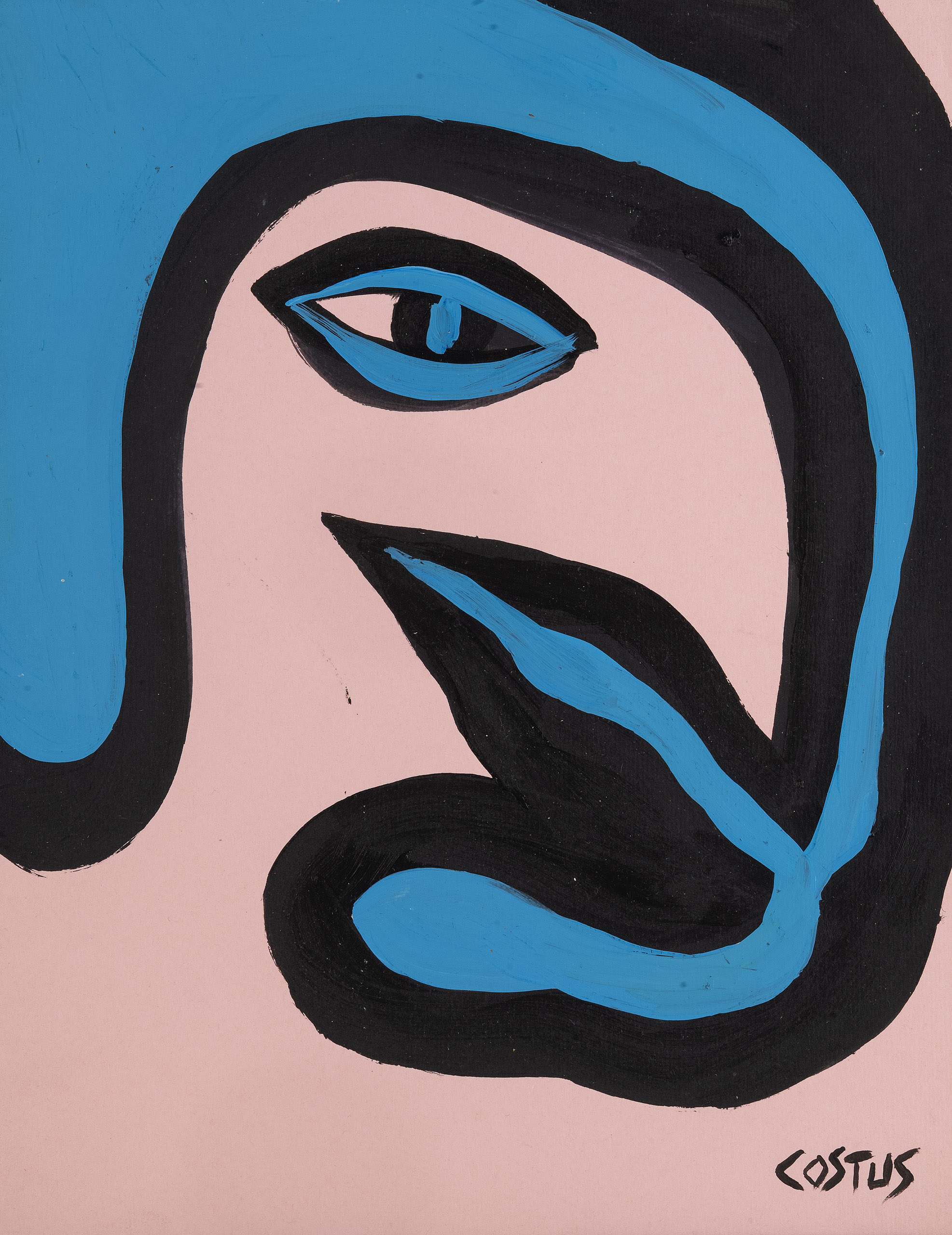
“Pájaro salmón y negro sobre azul” is a compact yet highly refined example of the Costus graphic vocabulary, executed in acrylic on cardboard and signed by the collective. The work’s modest dimensions (32.5 × 25.2 cm) belie its compositional clarity: with economy of line and a limited but striking palette, the piece distills a figurative suggestion into an almost emblematic sign. The title frames the viewer’s reading—bird, salmon, black, blue—yet the image functions primarily as an investigation into contour, negative space and chromatic contrast rather than as a literal depiction. This measured restraint is typical of Costus pieces in smaller formats, where immediacy and iconic presence are achieved through concentrated pictorial decisions.
Formally, the painting relies on broad, calligraphic strokes in black to define an organic shape that curls across a flat, delicate salmon ground. Within this black band a secondary register of blue is deployed, establishing a two-tone dialogue that both articulates volume and preserves planar clarity. The single eye motif, rendered with economy and a careful modulation of black and blue, becomes a focal punctuation—an index of subjectivity within an otherwise abstracted silhouette. Acrylic on cardboard produces a matte, tactile surface that absorbs light differently than canvas; here that material quality contributes to the piece’s quiet objecthood and invites close visual inspection of brush edge, paint density and the subtle shifts where pigment meets substrate.
Technically, the work exemplifies Costus’ command of line and negative space. The artist’s brushwork moves confidently between graphic outline and expressive filling, achieving a balance where gesture reads as both deliberate and spontaneous. The cardboard support encourages immediate mark-making and a particular textural response to acrylic that differs from stretched canvas—the result is a work that feels simultaneously raw and considered. Signed by Costus, the piece sits within the duo’s broader practice of translating figurative motifs into pared-down emblems, a strategy that allowed them to produce images that were at once accessible and formally rigorous.
From a collecting perspective, Pájaro salmón y negro sobre azul is significant because it exemplifies how Costus negotiated scale and materiality without sacrificing visual impact. Small-format works of this type are often sought after by collectors wishing to assemble coherent groups of study pieces or to include emblematic examples of an artist’s graphic language in more intimate spaces. The piece’s condition, signature and clearly articulated hand make it appropriate both for private interiors and as an anchoring work within curated displays focused on late 20th-century Spanish figurative experiments. Its economy of means—limited palette, decisive line, and compact support—creates a concentrated aesthetic statement that resonates beyond its physical boundaries.
In summary, Pájaro salmón y negro sobre azul is a distilled expression of Costus’ approach to symbol and form: an image that converts figuration into emblem through disciplined chromatic choices and confident draughtsmanship. For the collector or institution interested in the interplay between graphic reduction and figurative suggestion, this work offers a compact, materially interesting and historically rooted example of the duo’s practice.


 No products in the cart.