
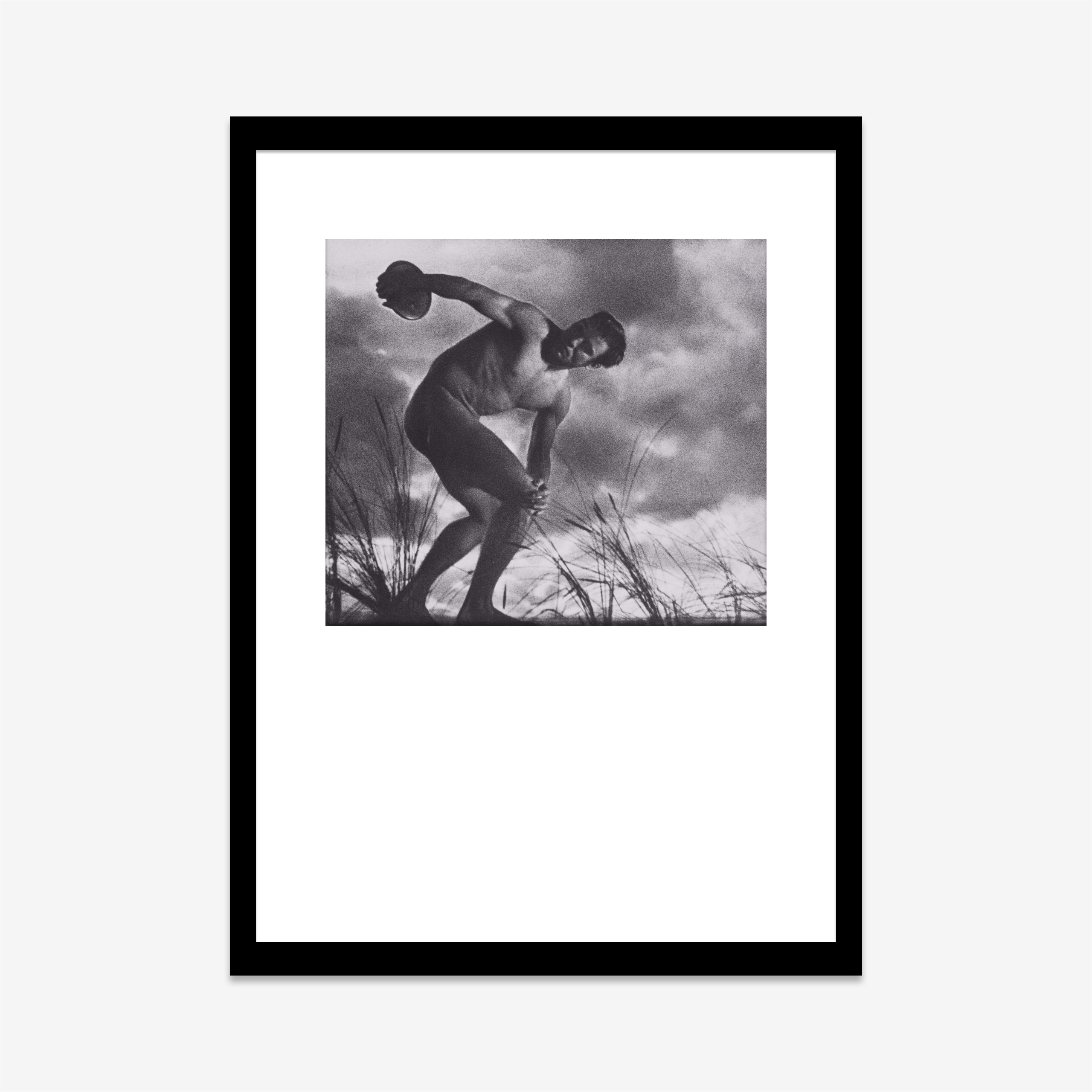

Leni Riefenstahl remains one of the most controversial yet technically groundbreaking figures in the history of 20th-century visual media. This specific work, titled “Lebendige Antike” (Living Antiquity), originates from her extensive documentation of the 1936 Berlin Olympic Games. In this piece, Riefenstahl seeks to transcend sports reportage by elevating the athlete to a heroic, mythological status. By recreating the pose of the classical Greek Discobolus within a natural landscape, the artist establishes a direct link between the modern human form and ancient aesthetic ideals. Consequently, the work serves as a definitive example of her obsession with physical perfection, symmetry, and the monumentalization of the subject.
The technique displayed in this photograph showcases Riefenstahl’s mastery of cinematic lighting and outdoor composition. Specifically, she utilizes a low-angle perspective to make the athlete appear larger than life against a dramatic, cloudy sky. This “heroic” angle was a signature element of her visual language. Furthermore, the use of infrared-sensitive film—or high-contrast filters—allows for the stark separation between the muscular torso and the atmospheric background. The inclusion of tall grasses in the foreground adds a layer of depth and texture, grounding the classical pose in a raw, elemental environment. As a result, the image possesses a high-contrast grain that emphasizes the sculptural quality of the skin and bone.


 No products in the cart.