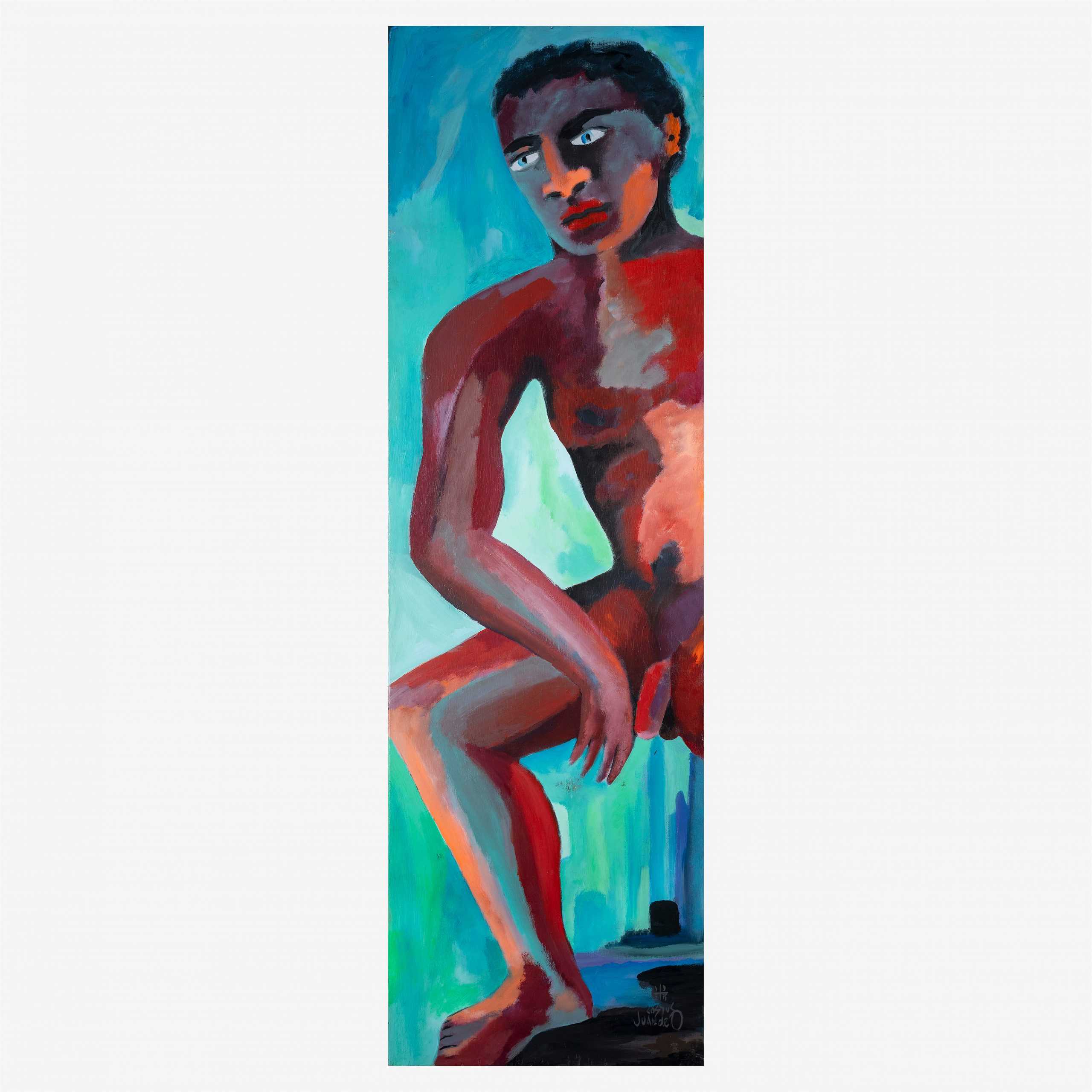
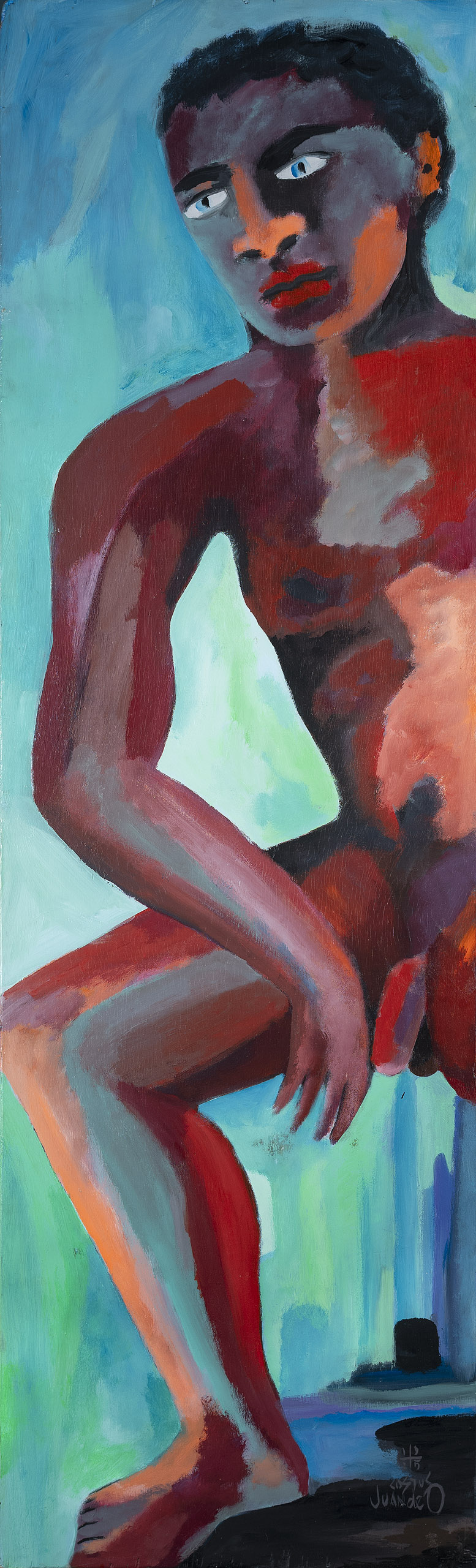
“Mami que será lo que tiene el negro” is a paradigmatic work from the mature period of Costus, the artistic duo formed by Juan Carrero Galofré (Juan de O.) and Enrique Naya. Created in 1985, this piece reflects their distinctive visual language, where figurative representation, chromatic intensity, and cultural symbolism converge to construct images that are as visually direct as they are conceptually layered. The elongated vertical format reinforces the presence and stature of the central figure, offering a stage-like composition that is characteristic of the duo’s pictorial explorations during the mid-1980s.
Executed in acrylic on panel, the painting demonstrates the technical precision that defined Costus’ collaborative production. Acrylic’s rapid drying time and capacity for saturated pigmentation allowed the artists to create bold color fields, sharp contrasts, and sculptural modeling of the human form. The result is a figure depicted with clarity and intention, defined by luminous tones and accentuated volumetric treatment that highlight the expressive potential of the body.
The title, drawn from a culturally recognizable phrase within the Spanish-speaking world, introduces an additional layer of interpretation. Rather than functioning merely as a direct reference, it situates the artwork within a dialogue about representation, exoticism, and the gaze. Costus often engaged with themes related to identity—racial, sexual, and bodily—approaching them through a hybrid visual language that combined pop sensibilities, theatrical codes, and expressive painting. In this context, the figure becomes both subject and symbol, embodying questions around visibility, desire, and cultural narratives.
This work also aligns with a broader body of pieces in which Juan de O. and Enrique Naya reexamined the male figure, frequently portraying it with a monumental yet stylized presence. The narrow format intensifies this effect, guiding the viewer’s attention vertically and creating a sense of immediacy and intimacy. The composition invites contemplation not through gesture or movement, but through the poised assertiveness of the figure itself.
For collectors, curators, and art professionals, “mami que será lo que tiene el negro” stands as a significant example of Costus’ exploration of identity and representation during a defining artistic period. Its technical execution, conceptual depth, and cultural resonance make it an important addition to any serious collection focused on Spanish contemporary art or the evolution of figurative expression in the 1980s.


 No products in the cart.