


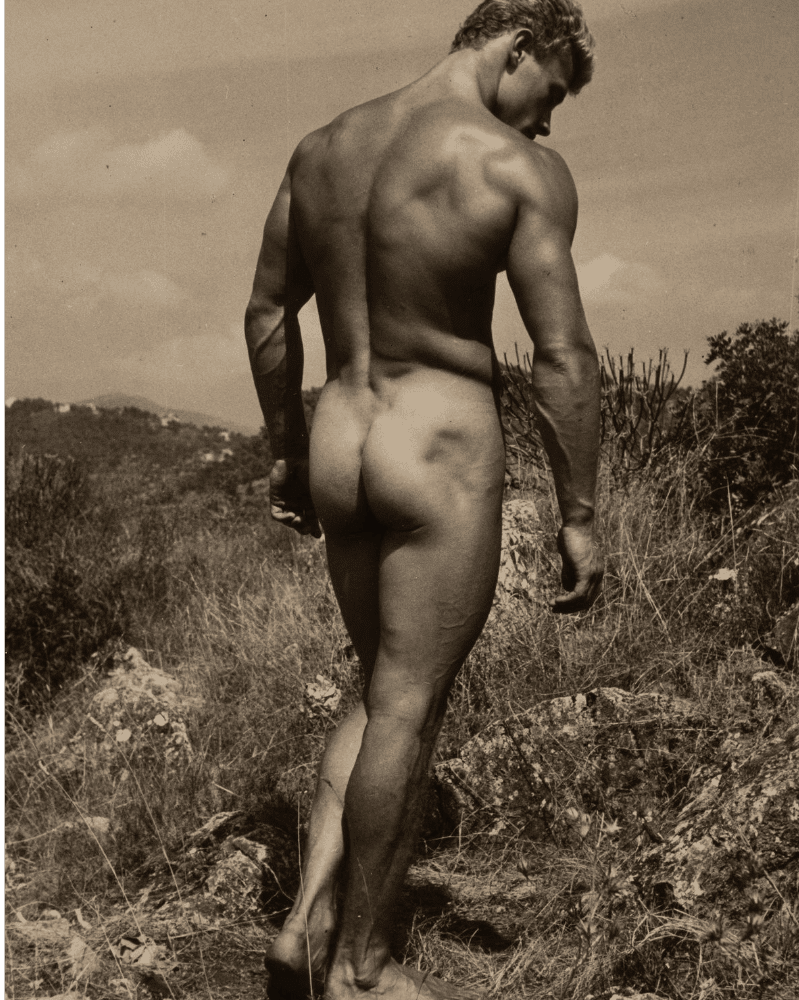
Don Whitman, the visionary behind the legendary Western Photography Guild (WPG) in Denver, was a central figure in the elevation of physique photography during the mid-20th century. In this iconic portrait of Bill Melby, Whitman demonstrates his meticulous approach to capturing the athletic ideal. Melby, a celebrated bodybuilder and Mr. America contender, is presented not merely as an athlete but as a living sculpture. By utilizing a controlled studio environment with a minimalist curtain backdrop, Whitman strips away narrative distractions. This focus allows the viewer to engage purely with the formal qualities of the subject—the symmetry, mass, and definition that defined the pinnacle of 1950s physical culture.
The technique employed in this work showcases Whitman’s mastery of monochrome tonal range and directional studio lighting. Specifically, the artist uses a three-quarter lighting setup to create deep shadows that emphasize the lateral muscles and the vascularity of the arms. This “low-key” lighting approach is a hallmark of the WPG style, designed to translate the three-dimensional volume of the human body onto a two-dimensional surface with maximum impact. Furthermore, the deliberate choice of a dynamic, mid-action pose adds a sense of tension and vitality to the frame. As a result, the photograph achieves a timeless, classical quality that references the athletic statues of antiquity while firmly inhabiting the modern photographic era.




 No products in the cart.