
About “Sailor”
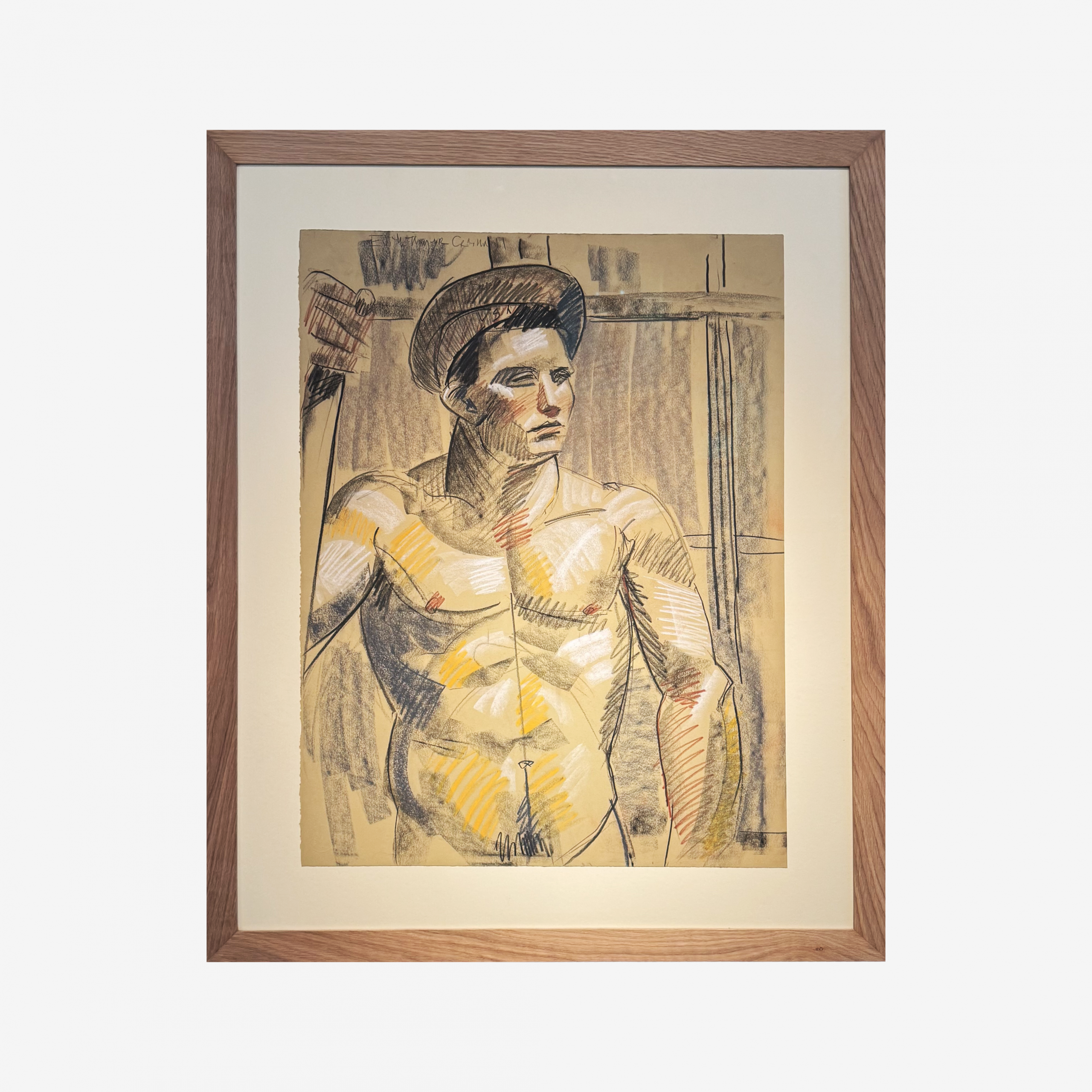
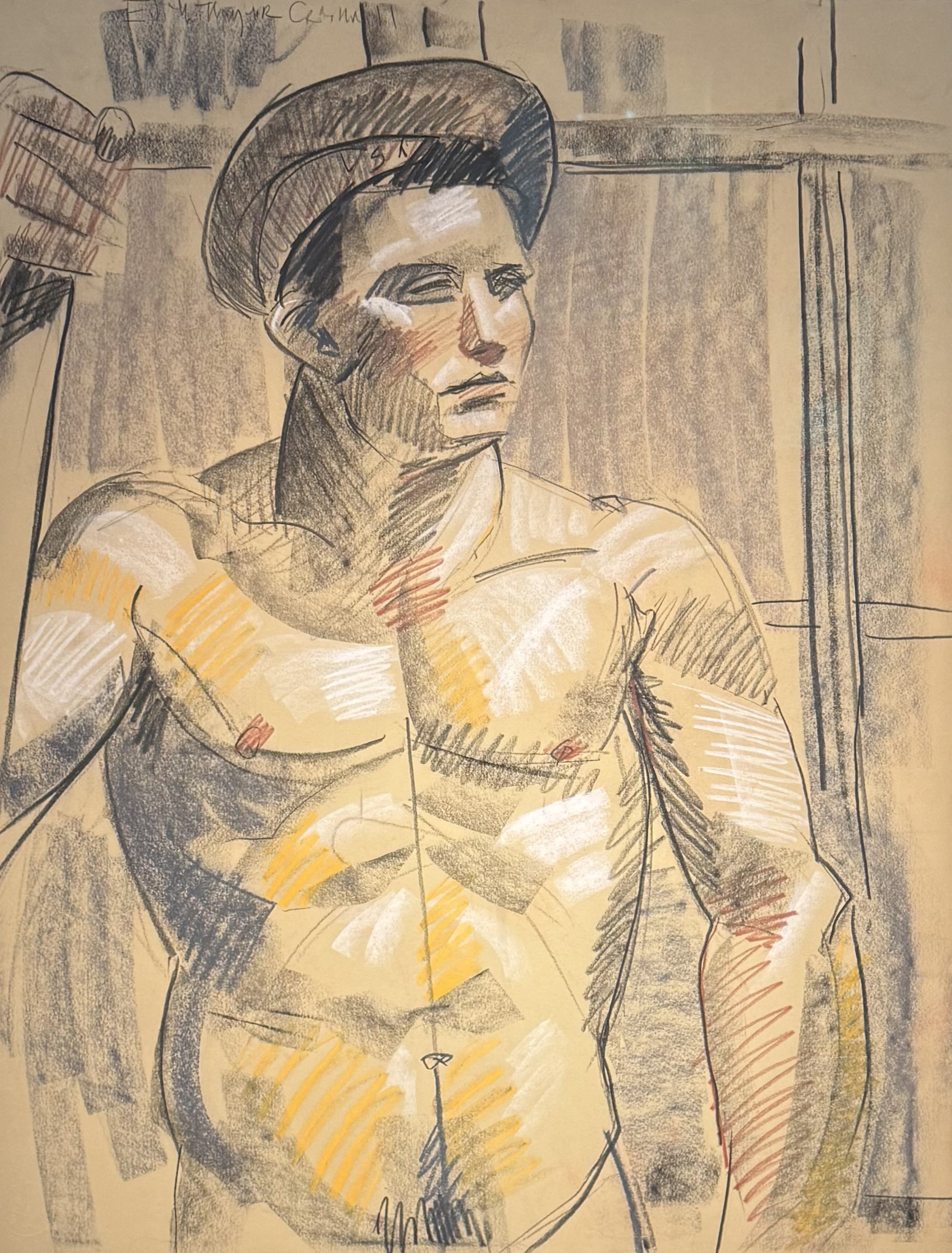
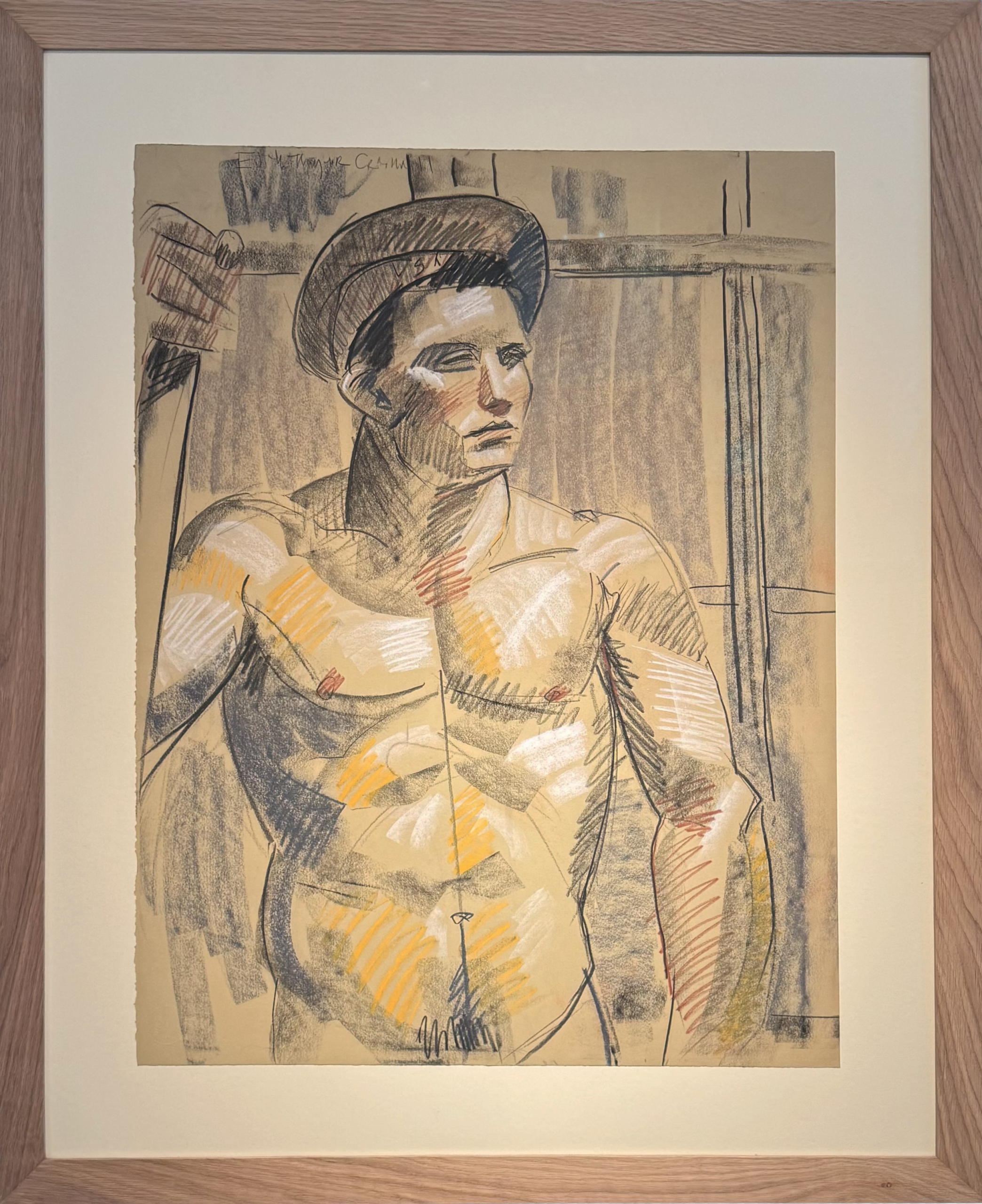
In Sailor (2000), Mark Beard presents a large-scale figurative drawing in which a sailor—bare-chested and wearing a brimmed cap—holds a paused, self-contained pose that feels caught between labour and reverie. Set against a pared-back structural backdrop of vertical and horizontal lines, the figure appears framed by an interior architecture suggestive of paneling, windows, or shipboard partitions. This understated setting doesn’t describe a specific place so much as it creates a stage: a quiet, rectilinear grid that stabilizes the composition and heightens the physical immediacy of the body.
Beard’s handling of line and tone is decisive. Pencil and charcoal establish the skeleton of the image—firm contours, incisive facial planes, and dense shadow passages—while pastel introduces warmth and vibration through selective colour accents. The artist models the torso with a confident interplay between contour and mass: dark, weighty shadows deepen the neck and flank, while lighter, broken strokes skim across the chest, shoulder, and abdomen, suggesting reflected light. The yellow marks—laid in oblique bands and quick, energetic touches—read like flashes of illumination, as if light is striking and rebounding off a nearby surface. These chromatic notes bring a contemporary edge to what might otherwise be a classical life-study, turning anatomy into an arena for atmosphere and emotion.
The sailor’s expression—eyes cast away from the viewer—adds psychological charge. This is not merely an academic study of musculature; it is a portrait in the fullest sense, where posture, gaze, and the tension of the raised arm imply an off-frame narrative. The cap functions as a key iconographic cue: with a single element of dress, the figure becomes both individual and type, anchored in the long visual tradition of the sailor as symbol of mobility, discipline, and communal identity. Yet the drawing resists cliché. The body is idealized but not polished; the visible construction lines, hatching, and revisions maintain a sense of process and proximity, as though we are witnessing the artist’s thinking in real time.
Formally, the work thrives on its balance of clarity and ambiguity. The contours assert presence, while the tonal fields in the background remain airy and suggestive, allowing the figure to emerge with sculptural force. The cropping and near-photographic immediacy—especially the arm’s placement and the figure’s slight turn—create a modern sensibility, reinforcing the idea of an observed moment rather than a posed tableau. There is also a compelling duality in the surface: charcoal’s velvety density contrasts with pastel’s luminous softness, producing a tactile richness that rewards close viewing.
Within the broader context of late-20th- and early-21st-century drawing, Sailor aligns with a renewed commitment to the figure as a site of identity and cultural memory. The sailor motif carries a dense constellation of associations—work and travel, desire and myth, camaraderie and solitude—and Beard taps into that reservoir without overstating it. The result is an image that reads simultaneously as an emblem and a person: strong, vulnerable, iconic, and private all at once.
The sheet measures 80 × 58 cm, while the framed dimensions are 99.50 × 79.50 cm—two distinct measurements that emphasize the work’s substantial physical presence in both its raw and presented states. The drawing is confirmed unsigned, and the model’s name is inscribed at the top, reinforcing its studio-based origin and the sense of a specific sitter behind the archetype.
Parallels and resonances: thematically, the work recalls modern and contemporary engagements with the sailor as cultural figure—an enduring motif in 20th-century visual culture—while materially it sits comfortably alongside large-format studio drawings that combine charcoal’s structural depth with pastel’s capacity for light and flesh-tones. In spirit, it also echoes figurative practices that privilege directness and psychological nuance over finish, where the honesty of the mark becomes part of the subject.




 No products in the cart.