

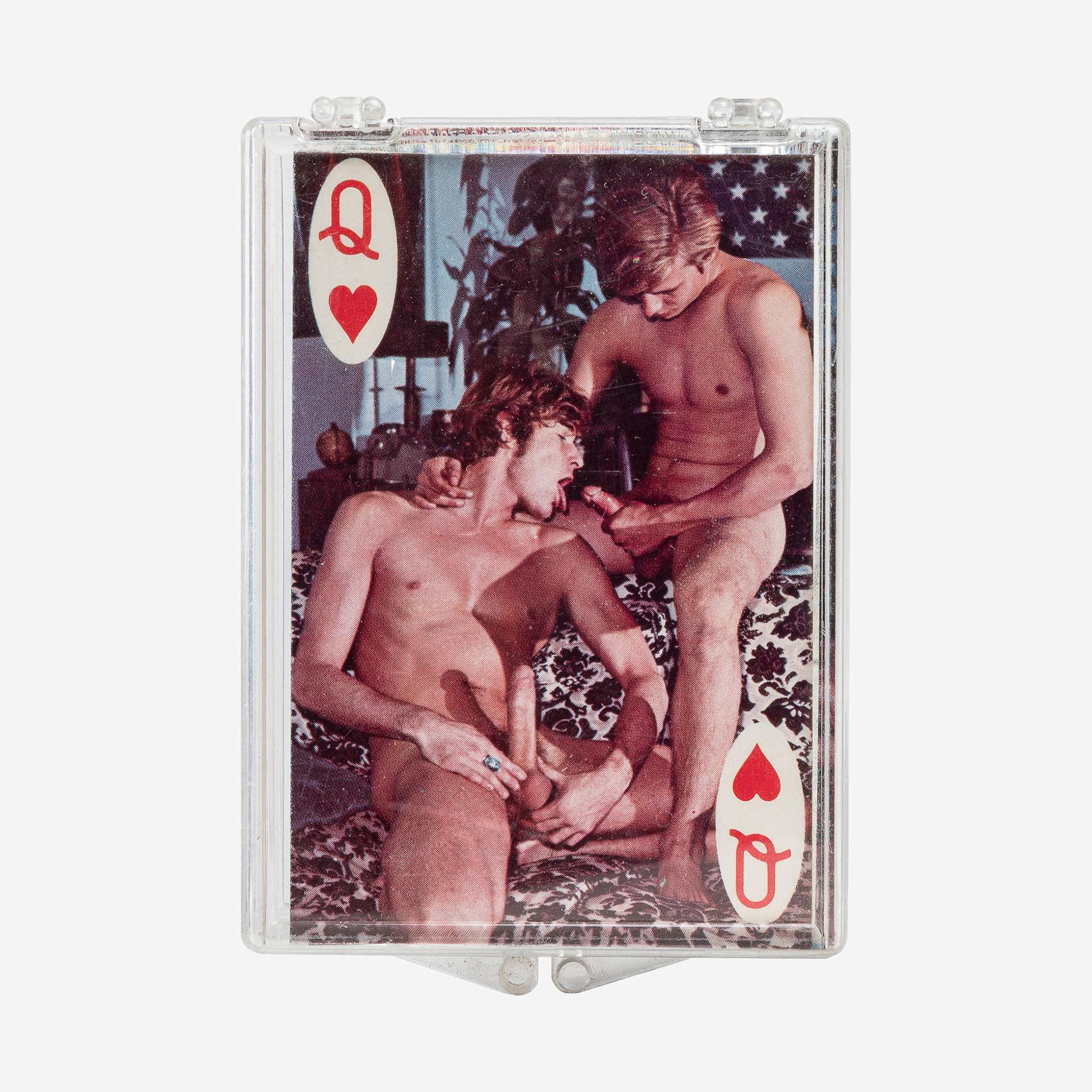
Erotic Masculine Playing Card
Before the photograph, before the printed book, desire found its way into the playing card. The erotic card deck is one of the oldest forms of commercially distributed erotic imagery, predating the postcard, the magazine and the film. Surviving examples from before the twentieth century are extraordinarily rare; those from the 1970s, though more recent, are themselves becoming scarce as objects not designed to last become, through survival alone, documents of their moment.
This card — the Queen of Hearts — is attributed to an anonymous maker and dates to circa 1970. The choice of the Queen as a vehicle for homoerotic male imagery is charged with cultural resonance: in the queer lexicon of the twentieth century, the Queen carried its own specific register, a term of self-description, of camp performance, of visibility and pride. Here, the card’s suit — Hearts — and its figure converge in an image that reads differently depending on who is looking, and when.
The deck to which this card belongs is slightly smaller in format than the standard European playing card, measuring 8.8 by 5.8 centimetres — a size that suggests production outside the mainstream, perhaps through smaller print runs intended for specialised distribution. Anonymous production of this kind was common in the erotic ephemera trade of the 1970s, where makers operated at the margins of legality and attribution was a liability rather than a credit.
Like all the pieces in the Curiosities collection at Imago Dei, this card is offered as an object of genuine historical and cultural interest — a small fragment of the material culture of male desire, produced at a moment when that desire was only beginning to find the language to name itself publicly.





 No products in the cart.