

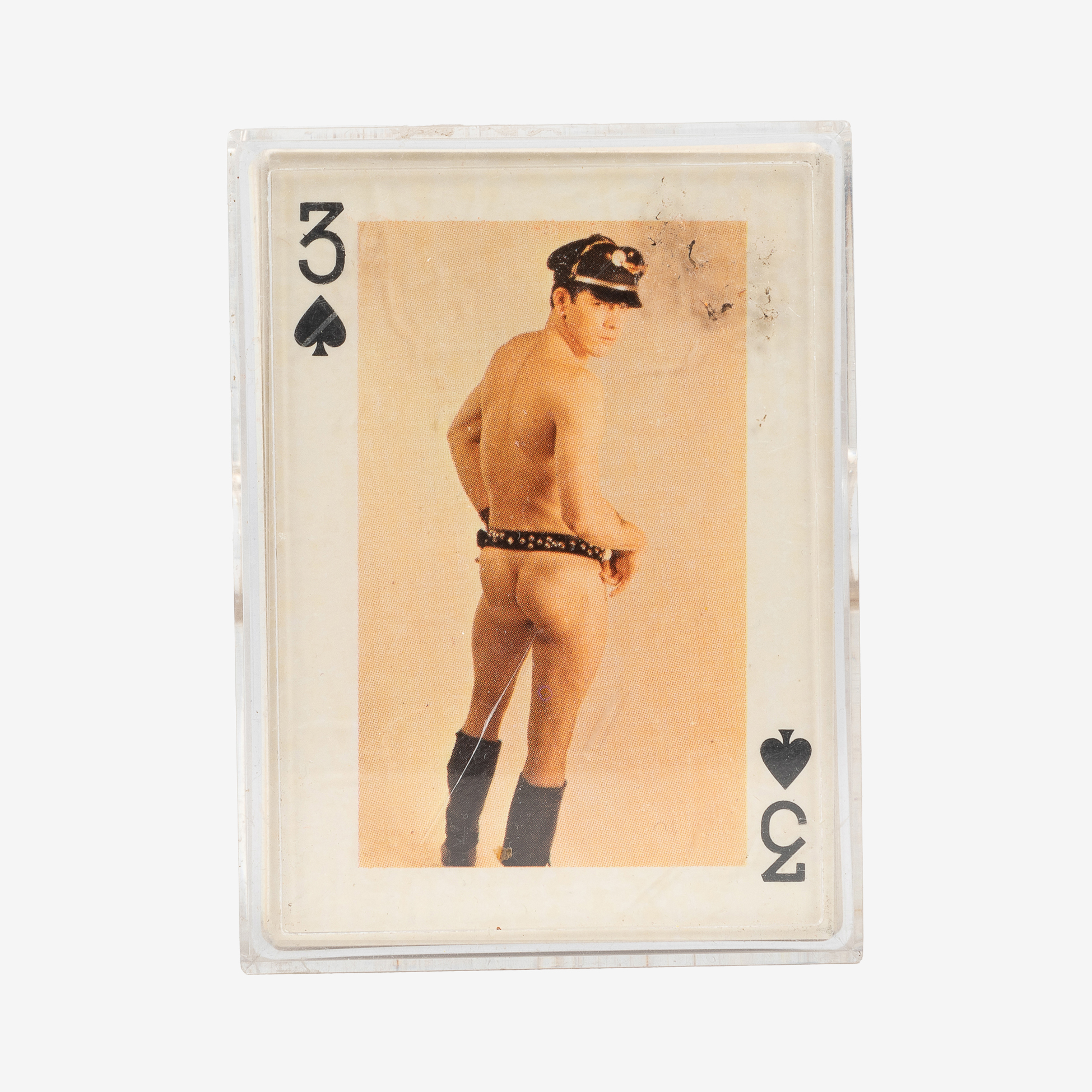
Erotic Masculine Playing Card
Among the most compelling objects in the history of erotic publishing, the playing card holds a particular fascination: it is at once utterly familiar and, in this form, entirely transgressive. Decks of cards with erotic imagery have existed in Europe since the early modern period, but the 1970s saw a notable flourishing of this format, particularly in Spain and southern Europe, as the loosening of censorship laws opened space for new forms of erotic expression in commercial print culture.
This card — the Three of Spades — depicts a male figure dressed in what appears to be a uniform or military-inflected costume, a recurring aesthetic in the homoerotic visual culture of the 1970s. The uniformed male body carries a long history of coded desire: from the beefcake photography of Athletic Model Guild to the leather subculture documented by Tom of Finland, the uniform signifies power, order and its transgression simultaneously. Here, that language is compressed into the intimate format of the playing card.
The Three of Spades belongs to a deck of 52 cards plus 2 jokers, each one featuring a different male figure, different pose, different register of masculine performance. Together they form a taxonomy of desire, a portrait gallery in miniature. Individually, each card functions as a self-contained image — a small, holdable work, designed to fit in the hand.
Part of the Curiosities collection at Imago Dei, this card is presented as what it is: a genuine artefact of 1970s erotic print culture, produced at a moment of significant social change, when the visibility of male desire — and particularly of homoerotic desire — was beginning, tentatively, to find legitimate form.







 No products in the cart.