

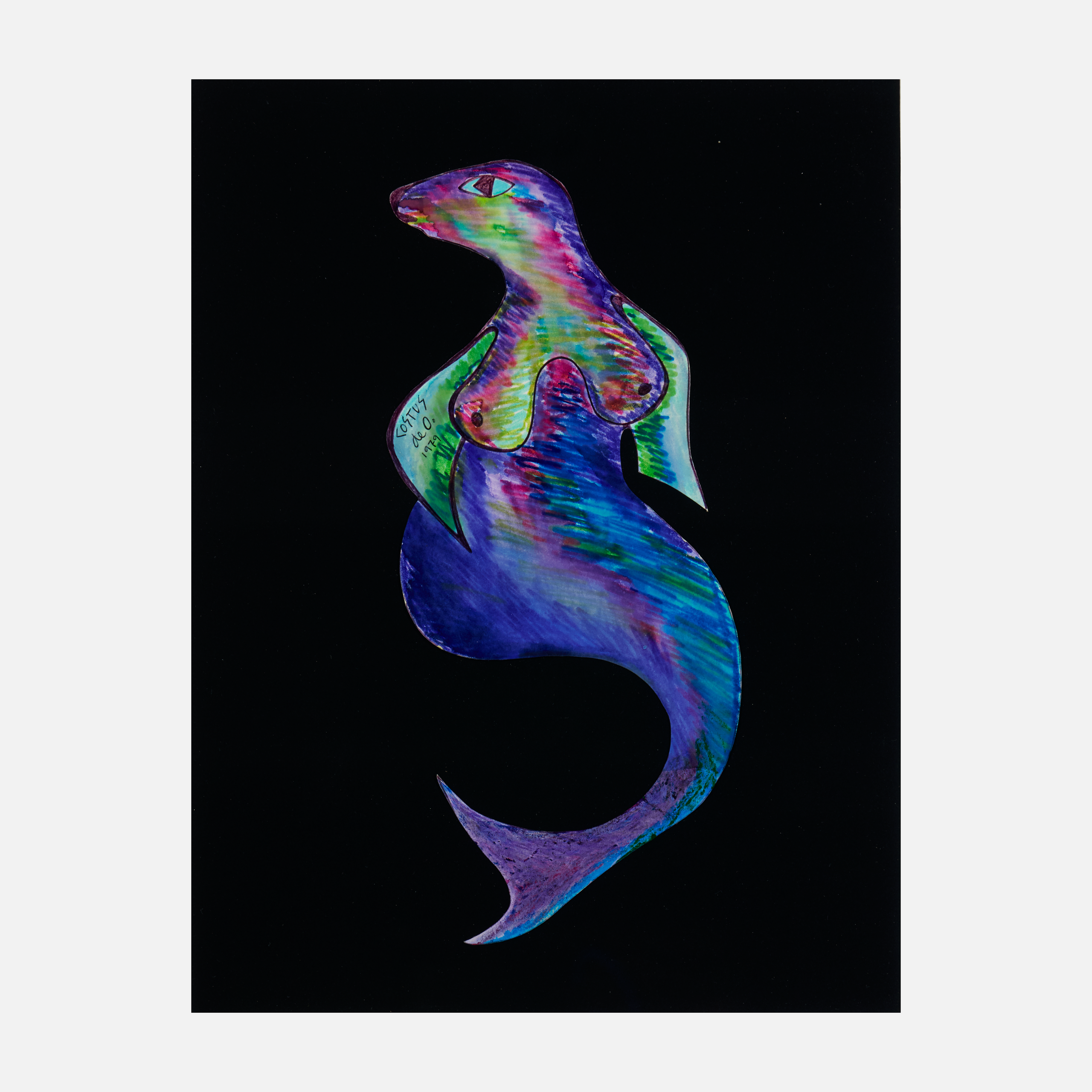
Sirena (1979) belongs to the recortables series and is among the earliest works in this selection. The mermaid, a figure with deep roots in Mediterranean mythology, is rendered with the freshness and graphic confidence of the duo’s earliest mature work. Signed and dated 1979, this is a documented piece from the formative period of the Costus collaboration.
The recortable format — cut-out figures on card, derived from popular illustrated paper dolls — represents one of the most inventive formal experiments in the Costus oeuvre. By working within this vernacular tradition, the duo simultaneously celebrated popular culture and asserted its equivalence with fine art practice.
Costus — Juan Carrero Galofré and Enrique Naya Igueravide — were among the defining artists of La Movida Madrileña, the social and cultural movement that transformed Spanish life after the end of the Franco dictatorship. Working in Madrid from the late 1970s until Carrero Galofré’s death from AIDS in 1989, they produced a body of work that combined pop aesthetics, Mediterranean chromatic intensity, gay male imagery, and an irrepressible visual energy that made them central figures in one of the most significant moments in contemporary Spanish cultural history.
Their work is immediately recognisable: flat, bold colour; figures drawn from popular culture, mythology, and everyday life; a refusal of hierarchy between high and low subject matter; and a consistent engagement with the male body as both formal and political subject. They worked across painting, drawing, mixed media, and the recortables, producing a diverse and formally inventive body of work in a relatively short time.
Works on paper and card from this period represent Costus at their most immediate and experimental: the scale demands economy, the medium rewards directness, and the pressure of the support enters directly into the pictorial calculation. These are not studies or preparatory works but fully resolved objects, signed and intended as autonomous statements within a practice that understood the work on paper as equivalent in status to the canvas painting.















 No products in the cart.