

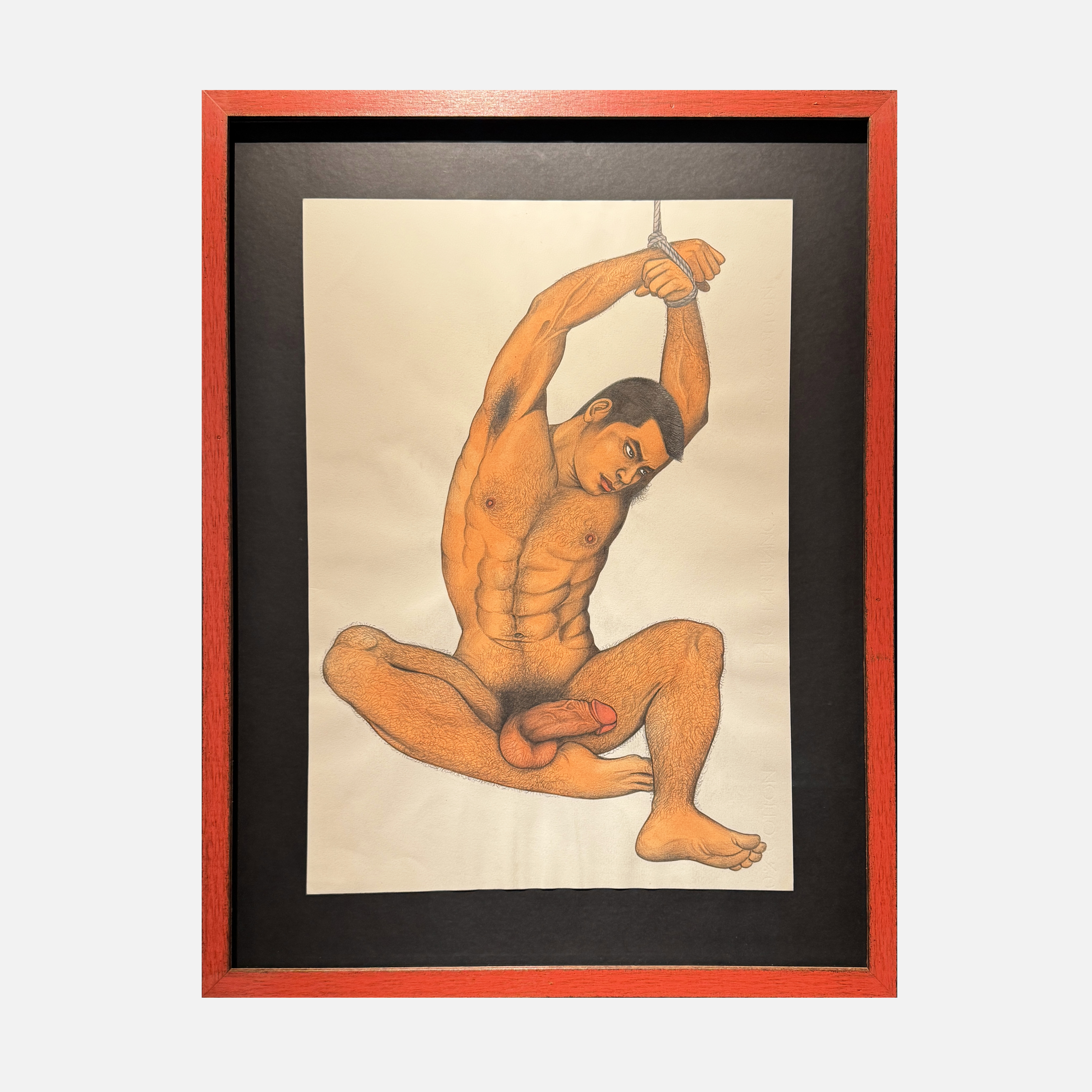
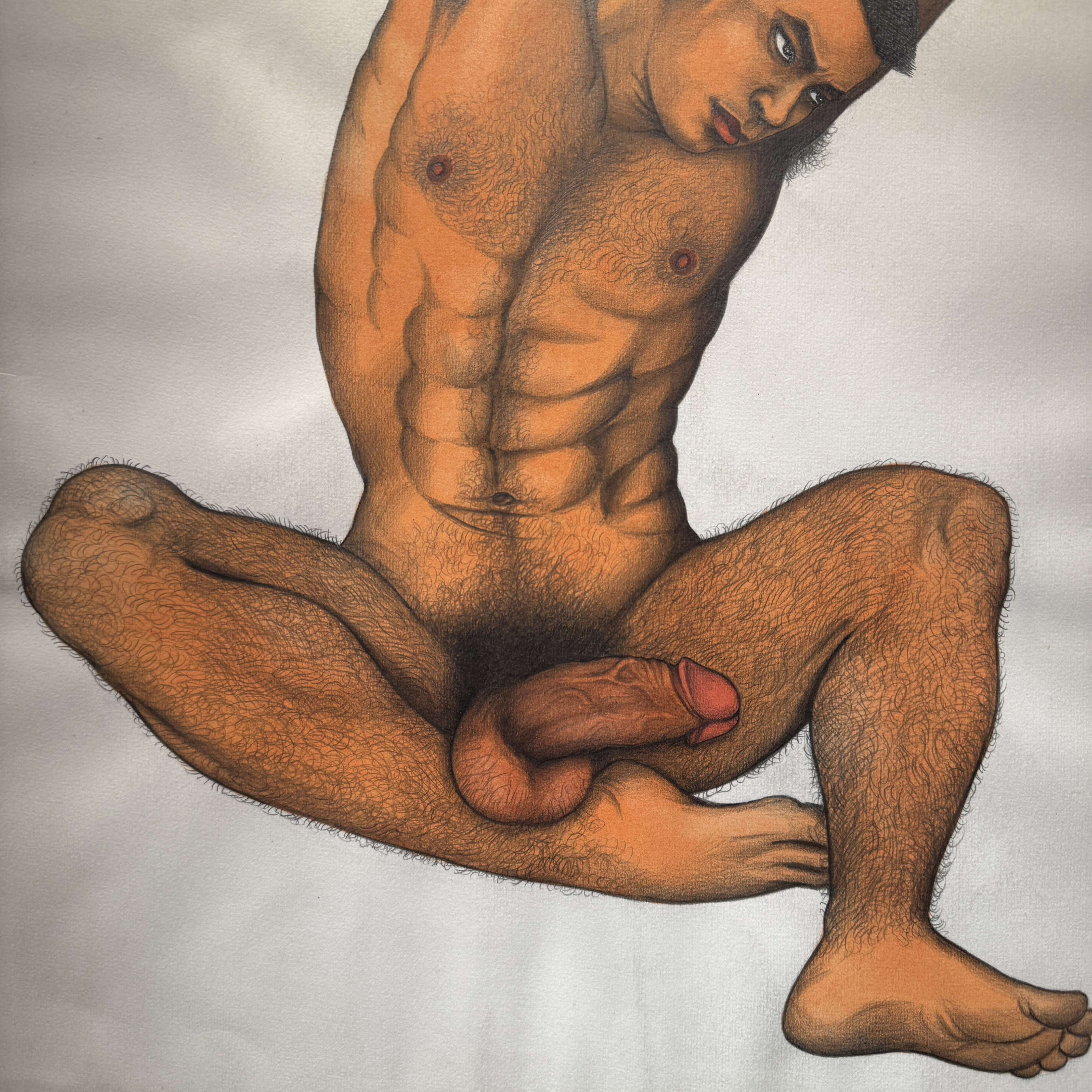
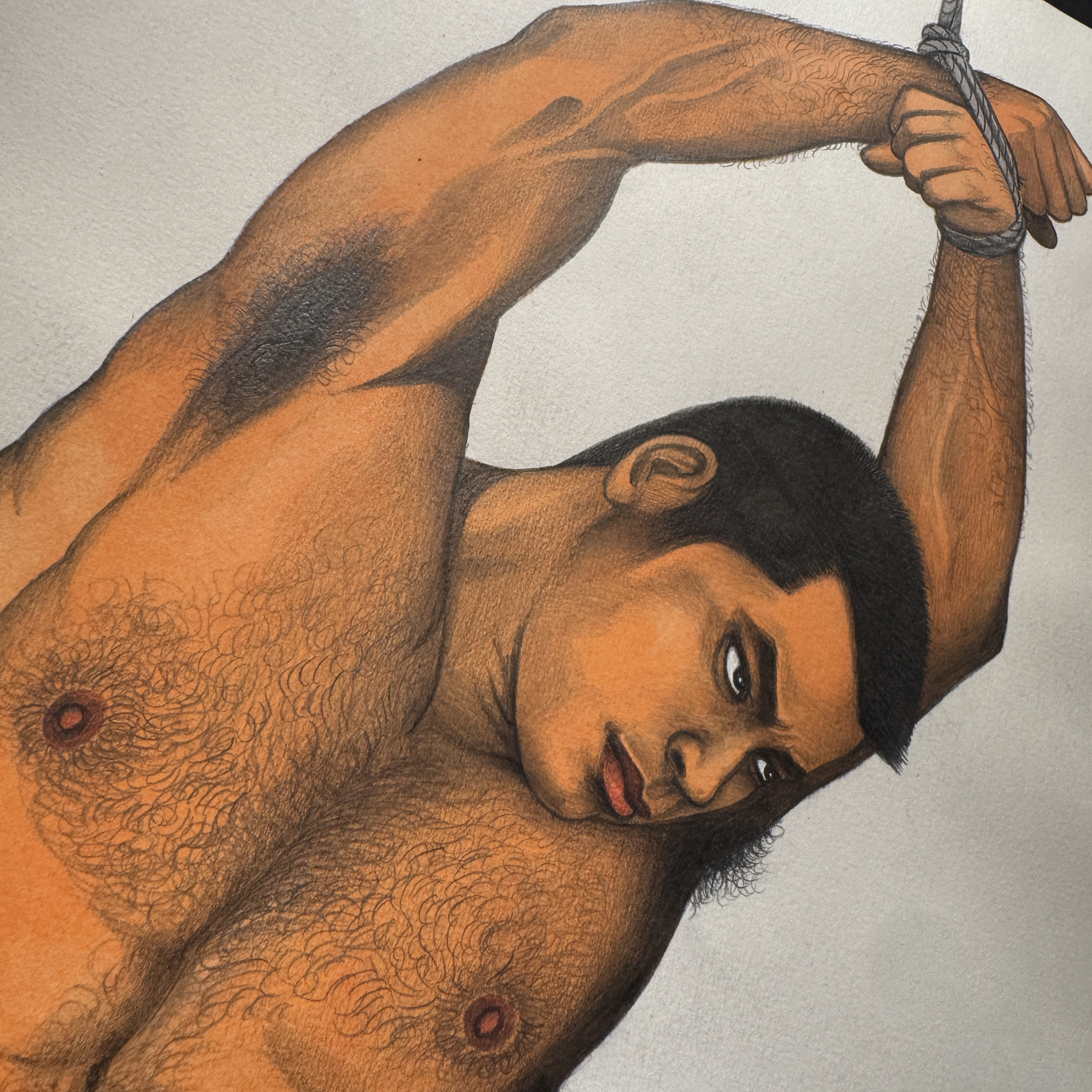
Untitled (Young man bound)
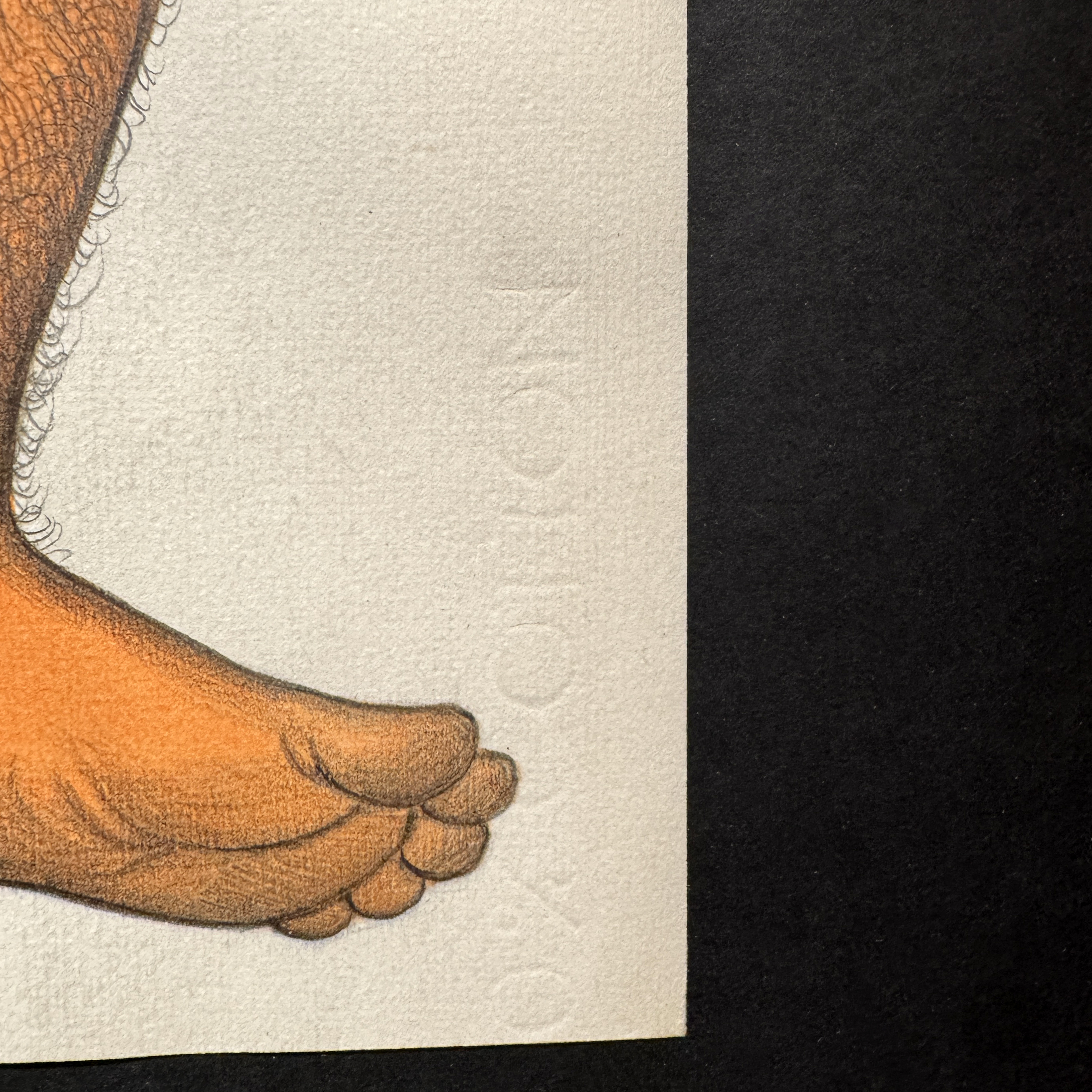
Go Mishima — born Tsuyoshi Yoshida (1939–1999) — was a Japanese artist whose work centered on the male nude within the aesthetic tradition of kinbaku, the Japanese art of rope bondage. Working in pencil and watercolor on paper, Mishima constructed a formal language in which the act of binding functions as compositional logic: the body is simultaneously subject and structure. This work from 1970 was part of the collection of the Leslie Lohman Museum of Art in New York (inventory nos. 2007.93.1 and 2016.52.63), one of the world’s pioneering institutions dedicated to LGBTQ+ art, and carries on its verso the artist’s stamp and two inventory numbers in pencil from the collection — a clear record of institutional provenance.
The drawing presents a young male figure in a seated, bound posture. The pencil establishes the essential contours and the architecture of the binding, while the watercolor — applied selectively and without excess — adds tonal modulation that renders the figure three-dimensional within a largely flat compositional field. Mishima’s characteristic precision is evident: every rope line performs a dual role as anatomical indicator and geometric form. The work reflects his sustained engagement with the shunga and ukiyo-e traditions of Japanese visual culture while operating within the conventions of Western drawing on paper.
At Imago Dei, this drawing occupies a position within a collection committed to figuration across cultural traditions. Its Leslie Lohman provenance connects it to a documented history of LGBTQ+ fine art collecting in the United States, lending the work a significance that extends beyond its formal properties.












 No products in the cart.